
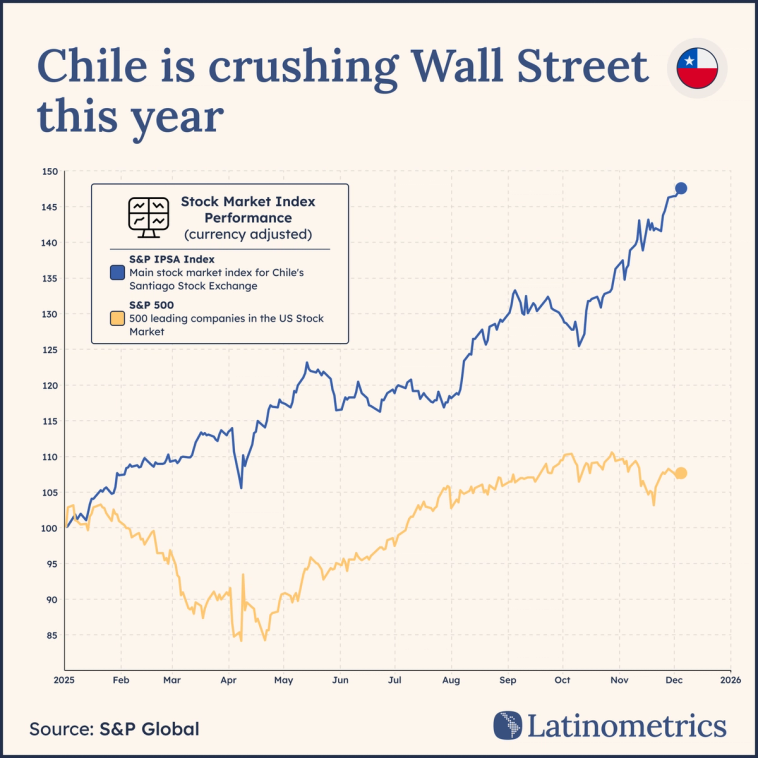
Chile is crushing Wall Street this year
What's behind Chilean markets' incredible performance this year?

Inflation may be up and global growth sluggish at best, but one area with respectable returns recently has been the stock market. After hemorrhaging value earlier this year on the back of some chaotic tariff announcements from the world’s top economy, markets have mostly rebounded.
Yet growth remains highly concentrated in today’s k-shaped economy. For example, the ongoing AI boom has led the Magnificent 7 tech giants of Alphabet, Amazon, Apple, Meta, Microsoft, Nvidia, and Tesla to substantially outperform the remainder of the classic S&P 500 index, continuing a trend seen in 2023. These seven companies today make up over a third of the overall index.
Which isn’t to say that even the S&P 500, hovering around its all-time high in terms of dollar value, has had the best year around. In fact, look south—far south—if you want to see even stronger gains.
Founded in 1893, the Santiago Stock Exchange (SSE) in Chile’s capital is the third-largest bourse in all of Latin America, behind only São Paulo’s B3 and Mexico City’s Bolsa Mexicana de Valores (BMV).
In 2022, the total market capitalization of domestic companies listed on the SSE reached 115% of Chile’s overall gross domestic product—an occurrence more commonly seen in highly-developed financial markets such as Canada, Japan, or the United States.
2025 was good to the SSE. As we shared in the Domingo Brief, the SSE’s growth of over 45% this year is nearly 6x that of the S&P 500’s measly 8% (we first reported +17% for the S&P 500, but 8% is currency-adjusted to the Chilean peso).
But what’s driving this impressive growth?
Well, over three-quarters of companies in Chile’s benchmark IPSA index have strengthened thus far this year. Combined profits have approached $10B, reflecting a 6% growth over last year.
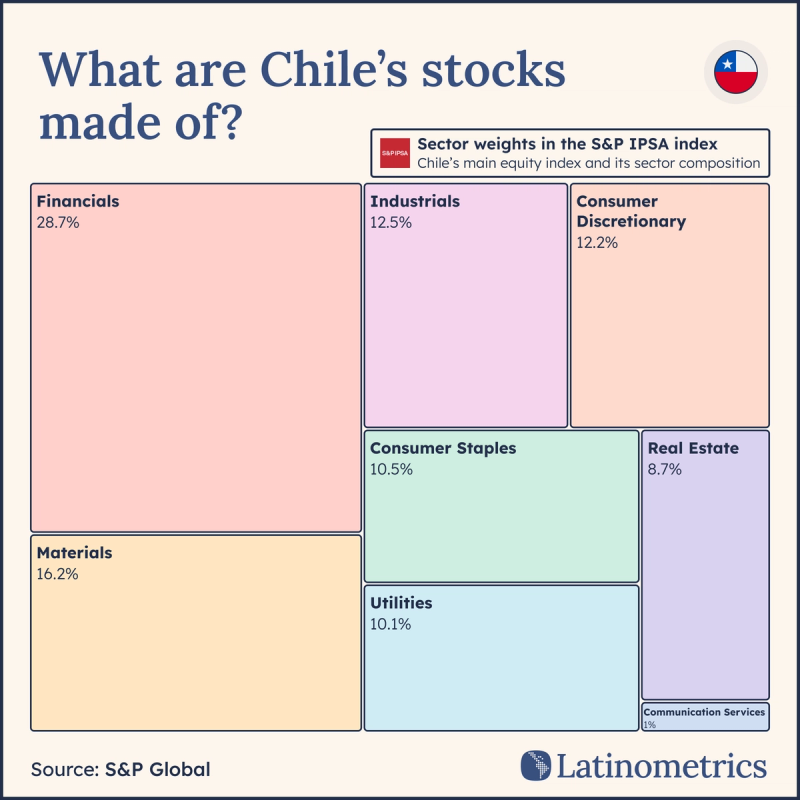
Regional aviation hegemon LATAM Airlines has led with nearly $1B in aggregate earnings, followed by banking heavyweights like Banco de Chile and Santander’s local subsidiary.
Even SQM, the world’s biggest lithium producer, has managed to reverse its fortunes—while last year the firm saw losses of nearly $530M, this year has thus far seen profits of over $400M.


