
Will China become LatAm's largest trade partner?
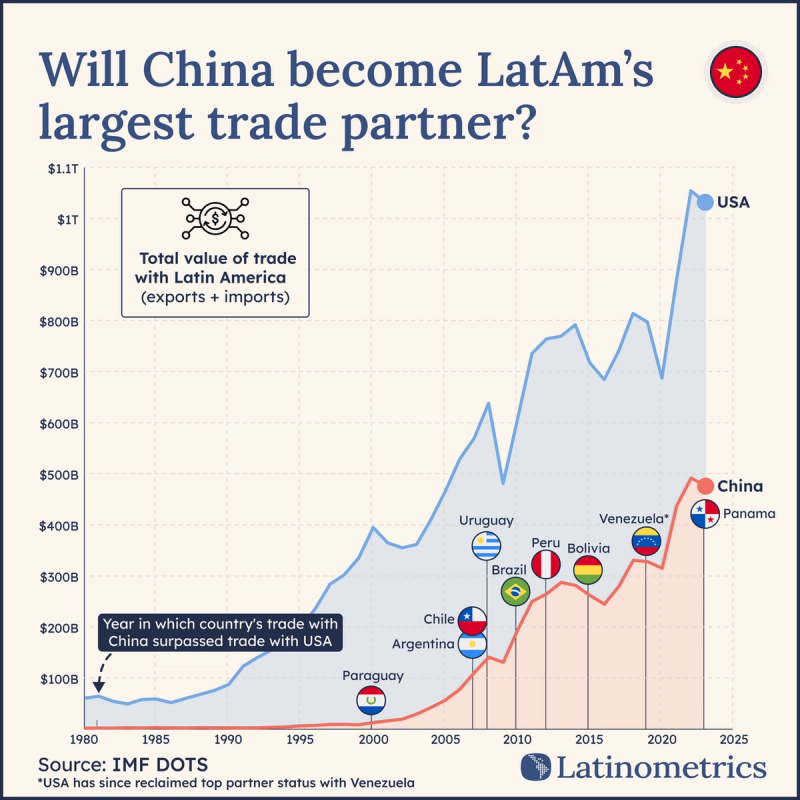
China's LatAm trade exploded to $500B by 2022, but Colombia stands out as a surprising exception.

We asked Colombia's Former President Iván Duque about China trade.
Today we’re sharing part of our conversation with Iván Duque Márquez, Colombia’s President from 2018 to 2022, about China’s growing trade with Latin America.
Iván Duque and our Chief Editor Gabriel Cohen in Miami - 12/11/2024
If one trend has shifted Latin America’s political economy over the last two decades, it’s been the emergence of China as an economic superpower.
Let’s put it this way: at the turn of the century, two-way trade between China and our region broke just $14B. By 2022, it had reached nearly half a trillion dollars.
This trend has become especially pronounced in South America, where today Beijing is the largest trade partner of major regional economies such as Brazil, Chile, and Peru, as well as among the largest for other economies like Argentina and Venezuela.
One by one, the continent’s countries have begun trading more with China than with the historically-dominant United States, powered usually by soaring exports of everything from soybeans and oil to iron and copper.
Which isn’t to say this is merely a local trend. Increased trade with China is “not exclusive to Latin America—it’s the whole Western Hemisphere,” said Iván Duque Márquez, President of Colombia from 2018-2022 and a current Distinguished Fellow at the Wilson Center, in conversation with Latinometrics. Even in the case of the United States, “maybe with the exception of 2023, China has been the major trading partner in the last decades.”
Duque notably served as the leader of the sole major South American economy to consistently maintain stronger trade ties with Washington, a trend seen more commonly among more northern countries like Mexico, Costa Rica, and the Dominican Republic.
Colombia today maintains a roughly $35B commercial relationship with its historical economic and security partner, roughly double the value of the Bogotá-Beijing trade volume.
“Colombia has been a strategic ally of the United States, and most of our trade has historically been prioritized towards the United States,” Duque said. “You see that with oil and gas, some of our minerals, flowers, coffee, bananas, and so on.”
But beyond Colombia, it’s clear that China has made large economic inroads in Latin America at large. For Duque, part of this stems from a question of respective trade policies.
“China has been more flexible in the last three to four years in order to open more trade opportunities for Latin American countries,” he explained. And Colombia’s southwestern neighbor provides a perfect example.
“Ecuador just signed a free trade agreement with China. They knocked [on] the US’s door for a long time, they didn’t get a response, and they got the response from China.”
Does this mean that countries like Colombia or Mexico are set to follow their peers in Brasilia and Quito towards a more China-dependent trade profile? Or is Latin America’s future to be found in market diversification and greater trade with other players like India and the European Union?


