
Coca Plantations in Colombia Reach an All-Time High
Colombia's coca yields 68% more cocaine than 20 years ago, fueling a $100B+ annual trade.

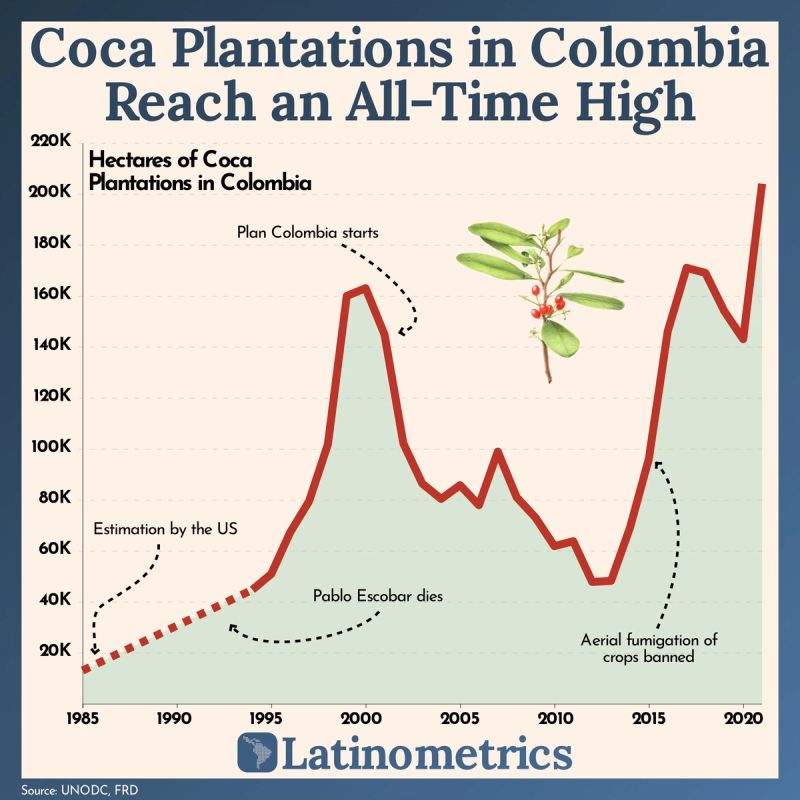
The cocaine trade is, for obvious reasons, hard to measure, but most estimates agree it's worth at least $100B+ annually.
The Medellín Cartel, led by Pablo Escobar in the 80s, and the most notable in popular culture, started as a processing and distribution operation for cocaine, using raw coca leaves from Peru and Bolivia. At its height, its operation brought in an estimated $60M in weekly profits, most of which came from the US and Europe.
Almost 40 years later, the Medellin Cartel no longer exists, and Colombia has become the world's capital of raw coca plantations (in addition to the production part). What's even more staggering is that coca land yields 68% more cocaine than it did 20 years ago.
The country has large rural areas that are extremely hard to develop due to its geography — mainly the Andean mountains and the Amazon rainforest, which covers 35% of Colombia. These inhospitable regions have historically left power voids that foster criminal activity, such as paramilitary groups like FARC and drug cartels.
More recent factors help explain the sudden increase in plantations:
New criminal group formations
A heavy flow of Venezuelan migrants
A drop in crop interventions by authorities
Poor economic conditions due to the pandemic
Banning of aerial fumigation of coca crops due to health concerns in 2015
The dissolution of Plan Colombia, a US-funded program to aid in the combating of drug cartels
Drug cartels usually recruit poor farmers from these regions to grow coca plants for them, either with money or by force. The violence and death toll then extend to all parts of the supply chain — to Mexico, with murders (mostly related to drug cartels) surging each year, to the US, where drug overdoses and mass incarcerations have been rampant. It's no wonder many countries have enacted policies and publications continue to fight for the legalization of cocaine.


