
Compared to OECD Countries, Mexico's Unemployment Rate is Surprisingly Low
Mexico's 2.9% unemployment is lowest since 2005, boosted by nearshoring despite high informality.

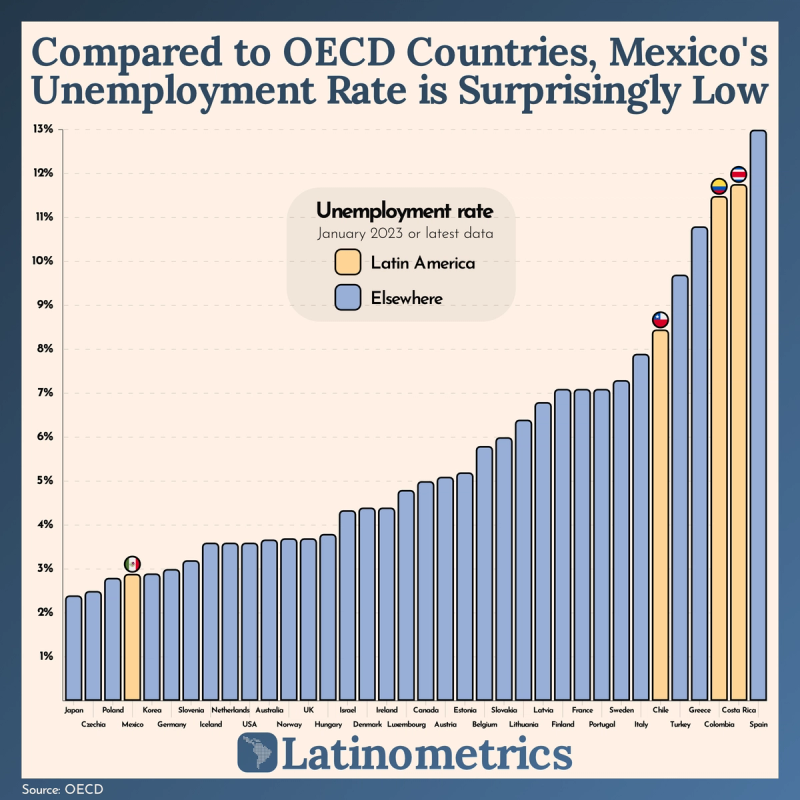
Latin American countries can be polar opposites regarding employment opportunities (or the lack thereof).
Global unemployment levels have been decreasing as countries experience a post-pandemic recovery. However, the world is now in what ILO defines as a "stagflationary episode" — simultaneously high inflation and low economic growth, something not seen since the 1970s.
In this context, LatAm's employment situation has steadily continued to recover. The latest data shows a 2.8% decrease since last year and an average unemployment rate of 7.3% — roughly pre-pandemic levels.
But there's wide variation across the region:
As you can see, Mexico has the 4th lowest unemployment rate among OECD countries, with a rate of 2.9%, exactly half the current world's average. While this might seem very positive, the country has always had lower-than-average unemployment rates. This is partly due to its significant rate of informality (55%), which makes employment indicators less reliable than those of countries with a more formal economy.
However, current unemployment is below pre-pandemic levels and is the lowest Mexico has seen since 2005. While many factors impact the country's unemployment, the nearshoring trend is among the most noteworthy. Industrial space and labor demand in Mexico are at a record high as manufacturing companies seek an alternative to China amid rising US tensions, boosting formal job creation in the country, potentially for the long run.
Countries like Costa Rica and Colombia are at the other end of the spectrum, with the 2nd and 3rd highest unemployment rates among OECD countries.
Interestingly, two economists — Valeria Lentini and Luis Fernando Mejia — have each independently defined their country as having a "dual" or "polarized" economy. A polarized economy is one in which most workers are divided into high-skilled, educated labor and low-skilled, uneducated labor.
The latter is the one that moves the employment needle as they are more vulnerable to unemployment in economic downturns. According to both economists, this leaves such countries with structurally high unemployment rates, and there's an opportunity for countries to provide job stability for such workers.


