
Costa Rica Has the Highest Unemployment in LatAm
Costa Rica's 11.5% unemployment is high for LatAm, but Guatemala's 2.6% hides 70% informal work.


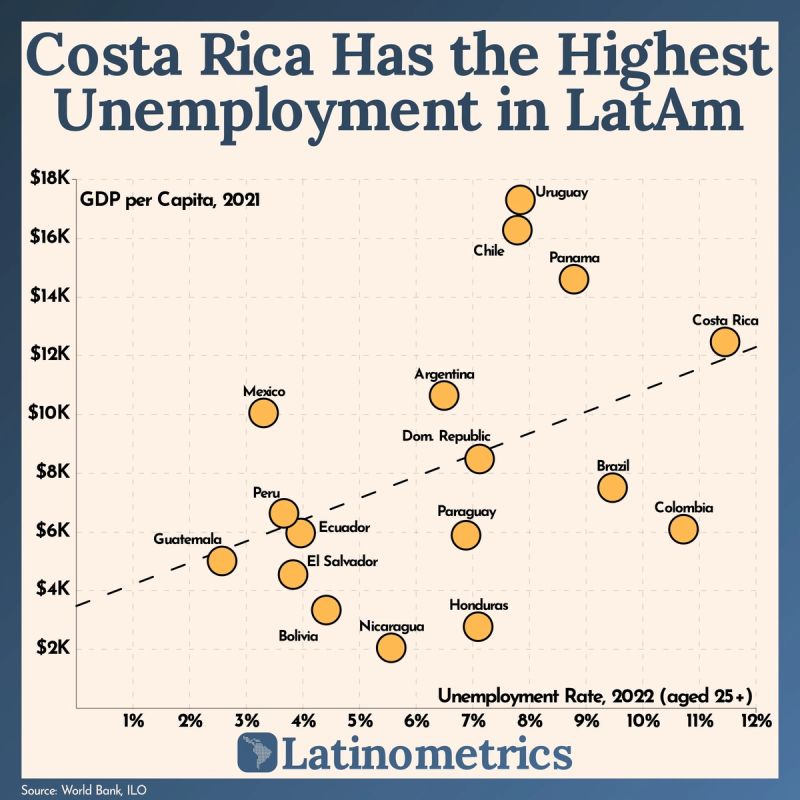
This week, we bring another counter-intuitive graph: richer Latin American countries have relatively high unemployment rates. We'll get into why that is further down, but first, let's look at the current employment situation in the region as a whole.
Among people aged 15 and over, the unemployment rate in Latin America sits at 7%. This puts the region's rate above the world's 5.8%. However, there has been a notable post-pandemic recovery in the LatAm, and our unemployment is already below pre-pandemic levels.
Let's discuss two extremes in our graph: Costa Rica and Guatemala.
Costa Rica, a country with the 4th highest GDP per capita in LatAm, has the second-highest unemployment rate at 11.5%. Although there has been a recent recovery in the country, the pandemic has affected its employment numbers by slowing down its economy. It should also be noted that Costa Rica has the 3rd lowest informality rate in the region, which also impacts this indicator.
On the other hand, Guatemala, a country with one of the lowest GDPs per capita in the region, has the lowest unemployment rate, with 2.6%. But… Can we really trust this number?
Nope. While Guatemala may have one of the lowest unemployment rates in the region and the world, the indicator is deceiving — an estimated 70% of the country's economically active population is dedicated to informal work. This means there's very little formal employment in the country, and most of it is taken up. So while most people in Guatemala aren't technically unemployed, they might still be in poverty as their "jobs" consist of activities such as "selling anything on the street," as Luis Linares from ASIES put it.
Turning back to the main question: why do poor Latin American countries have such low unemployment?
We're not aware of conclusive research on the matter. We hypothesize that unemployment indicators in developing countries are very deceptive, as it's common for them to have large informal sectors. Further, such metrics are likely more accurate in countries with less informality, like Costa Rica. Accuracy also means that Costa Rica's indicators are more likely to fluctuate along with economic conditions, as was the case with the pandemic.


