
Brazil is the sleeping giant of minerals
What could possibly bring together a MAGA firebrand and a Brazilian leftist icon? The answer lies buried deep underground.

A few months ago, the two largest countries in the Americas were at a diplomatic rupture, one involving 50% tariffs, political interference in the judicial process, and op-eds in The New York Times.
And by all accounts, Presidents Donald Trump and Lula da Silva will never be friends. But if Brazil and the United States have managed to move forward, critical minerals have played a large role in that.
Allow us to explain. Critical minerals (like copper and aluminum as well as fake-sounding ones like scandium and zirconium) are increasingly essential parts of the global economy and geopolitics. They’re needed for everything from phone batteries to hypersonic missiles to electric cars—a range which clearly makes their control quite important.
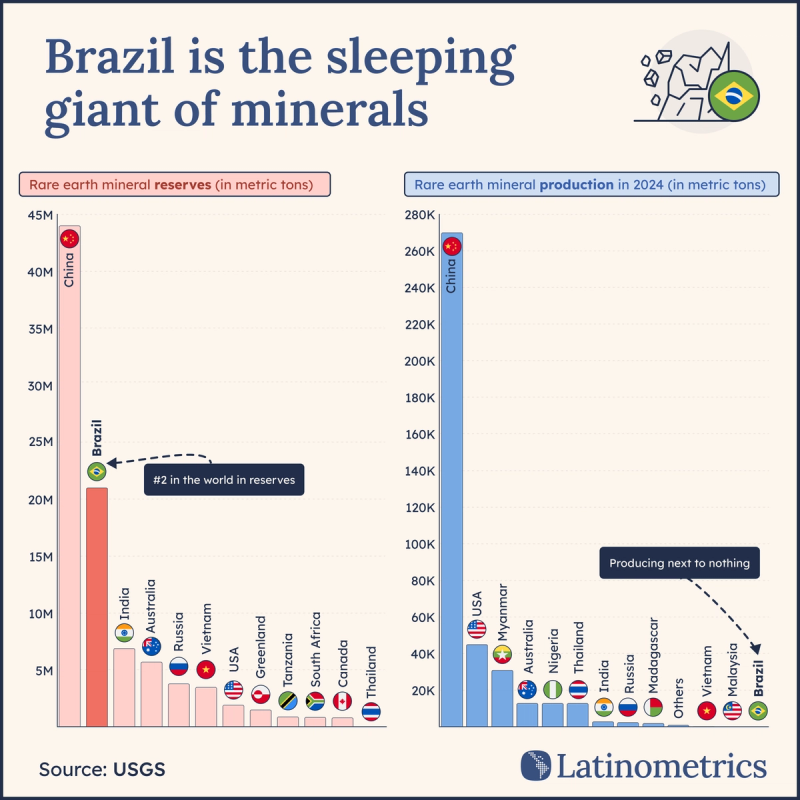
Yet one country basically dominates the excavation, and above all processing, of all critical minerals worldwide, giving it an edge in advanced industries and emerging technologies. China holds the world’s largest reserves of rare earth minerals (which make up a big part of critical minerals). More importantly, the country controls about 90% of global processing capacity, meaning it can weaponize export restrictions against any number of countries. Which brings us back to Brazil, and why even Uncle Sam has to play nice with his Brazilian cousin.
With roughly half the capacity of China, Brazil sits on the second-largest rare-earth reserves. Yet unlike its BRICS partner, Brazil has basically not even touched a fraction of its potential in terms of production and mining, let alone processing.
A lack of capital and know-how has held back Brazil from emerging as a second critical-mineral hub for the world. The US has seen this; while it has its own reserves of minerals like lithium including a major one in Nevada, it’s in desperate need of other sources to lessen its dependence on China. By many accounts, this minerals factor is even behind Trump’s recent obsession with Greenland.
So ideological divides aside, there is a clear joint interest for Brazil and the US on this matter. In 2024, Brazil exported roughly $40B in just iron and copper (both of which are found elsewhere in larger amounts). Here, meanwhile, the country has a truly unique opportunity to become the main competitor to China, in the process attracting hundreds of billions, perhaps even trillions, of dollars in international investment.
After all, as one analysis rang the alarm bell recently, the world at present completely lacks the production and processing necessary for its critical mineral needs. Doubly so outside of China.


