
Bank productivity in Latin America
How Argentina's banks beat inflation with US dollars.

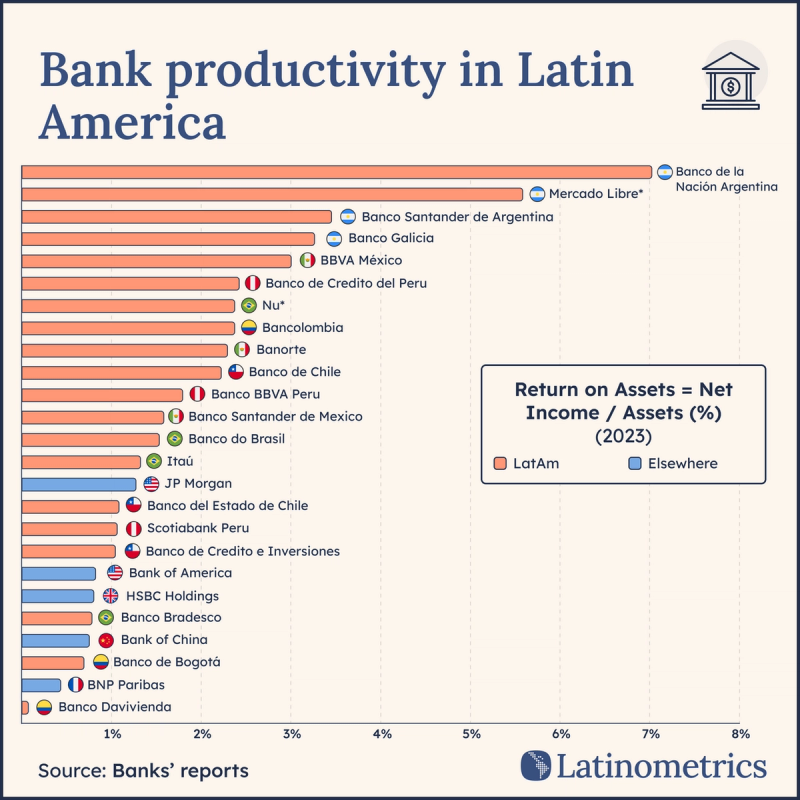
Today's story might be a bit dense, so hang in there with us. We're examining the productivity of Latin American banks, specifically through dividing profits by total assets to calculate the return on assets (ROA) of the region’s key banks.
In other words: how much profit can banks generate with what they manage?
Let's take the region's largest bank, Itaú, as an example. As we reported a few weeks ago, the bank manages a whopping $556B in assets. Last year, its operations generated $24B in revenue (roughly the equivalent of the entire GDP of Armenia), of which $7B was profit for the bank.
Divide that $7B by the total $556B in assets, and we see that Itaú generates profits equivalent to 1.33% of its total assets in a year.
Now that we've established what we're doing here, let's take a look. For fun, we added Mercado Libre and Nubank, the region's most valuable fintech firms, into the mix.
Argentinean banks top the list. The country's largest, Banco de la Nación, outpaces every other bank we examined by more than double.
Founded in 1891, Banco de la Nación is the largest public bank in the country. It was established to stabilize the economy after a financial crisis and has since played a vital role in supporting agriculture, industry, and commerce. The bank provides credit to businesses and individuals, focusing on rural and underserved areas.
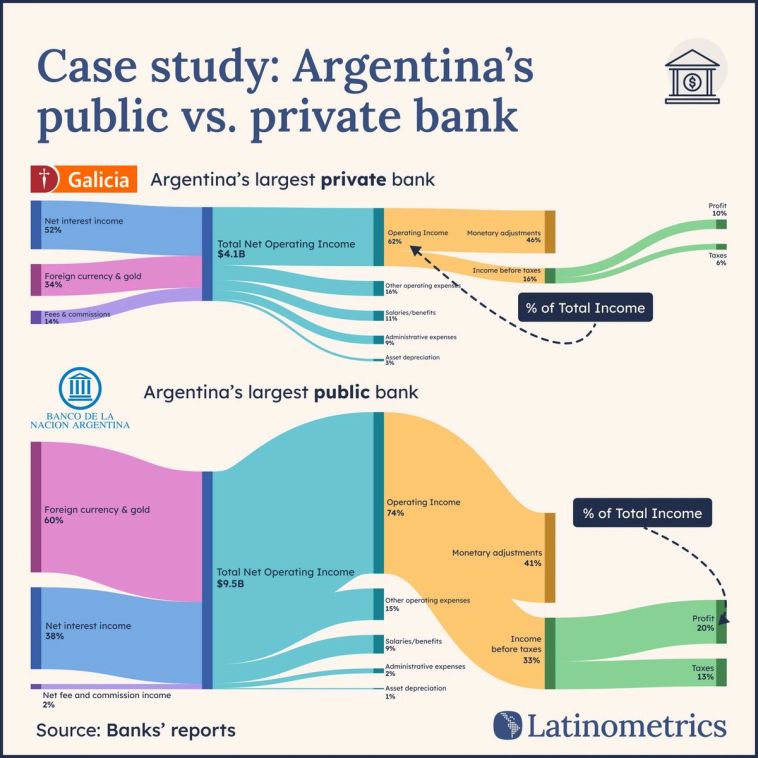
Naturally, we were curious to take a peek under the hood. We compared Banco de la Nación's balance sheet with that of Banco Galicia (Argentina's largest private bank).
Some key differences appear:
60% of Banco de la Nación's revenue comes from foreign currency and gold transactions; that same category represents only 34% of Banco Galicia's revenue.
What does this mean? Banco de la Nación holds a lot of US dollars and their appreciation against the Argentine peso accounts for most of the money they make.
But, and this is true for both banks, their Argentine peso holdings also represent the most significant expense, with 40%+ of their revenues ultimately lost due to inflation.
So basically, Banco de la Nación greatly protected itself against inflation in 2023 by holding US dollars.
Net interest income (a fancy way of saying money that comes through issuing loans) represents most of Banco Galicia's revenues. That's the traditional way of making money for banks.
Banco de la Nación enjoyed a 27% net profit, while Banco Galicia had 16%.
So, as with much of Argentina, inflation brings a lot of noise to the story. However, these numbers also reveal the importance and challenge of having a stable currency for the proper functioning of the country’s financial institutions.


