
FEMSA is Latin America's top employer
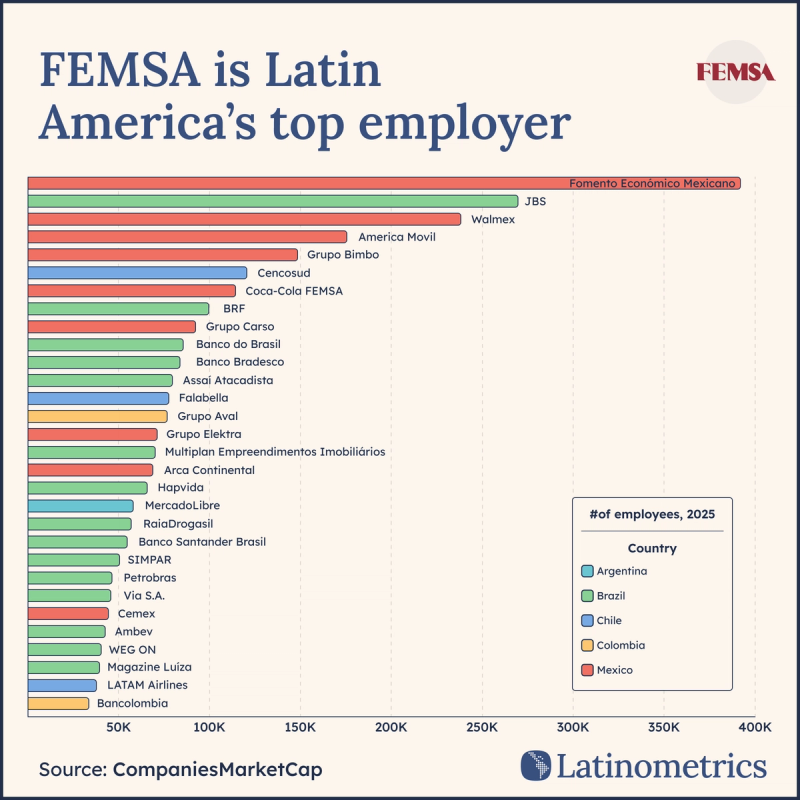
FEMSA is LatAm's largest employer with 350K+ staff, but Chile's firms are surprisingly large.

Every once in a while, a news story comes around that raises our eyebrows a bit.
For example, Bloomberg revealed this week that Joesley Batista, the controversial Brazilian billionaire and co-owner of meatpacking giant JBS, recently flew to Venezuela to convince autocrat Nicolás Maduro to resign and allow for a peaceful transition of power.
If it seems strange that a Brazilian beef tycoon is engaging in regime-change diplomacy, consider the following: JBS employs over 250K people, including 70K in North America alone, and is the world’s largest meat supplier. Ten years ago, Batista even helped broker a multibillion-dollar deal with the same Venezuelan regime for beef provisions. So this is far from his first rodeo.
JBS is also unique as the only Brazilian multinational firm to have over 100K employees. In contrast, one Chilean firm and five Mexican ones fall within this threshold—and no company’s a bigger player than FEMSA.
Even spinning out the highly profitable Coca-Cola division of its business, FEMSA towers above its competition. The world's largest bottler of Coca-Cola is also Mexico’s top private employer. Last year, it counted over $40B in sales, while across its factories and OXXO locations it counted over 350K employees.
Notably, we’re only tracking Latin American companies, meaning European-owned chains like Carrefour are excluded. But Walmex, the highly profitable and dominant Walmart subsidiary, is included with its nearly 150K employees spread across Mexico and Central America.
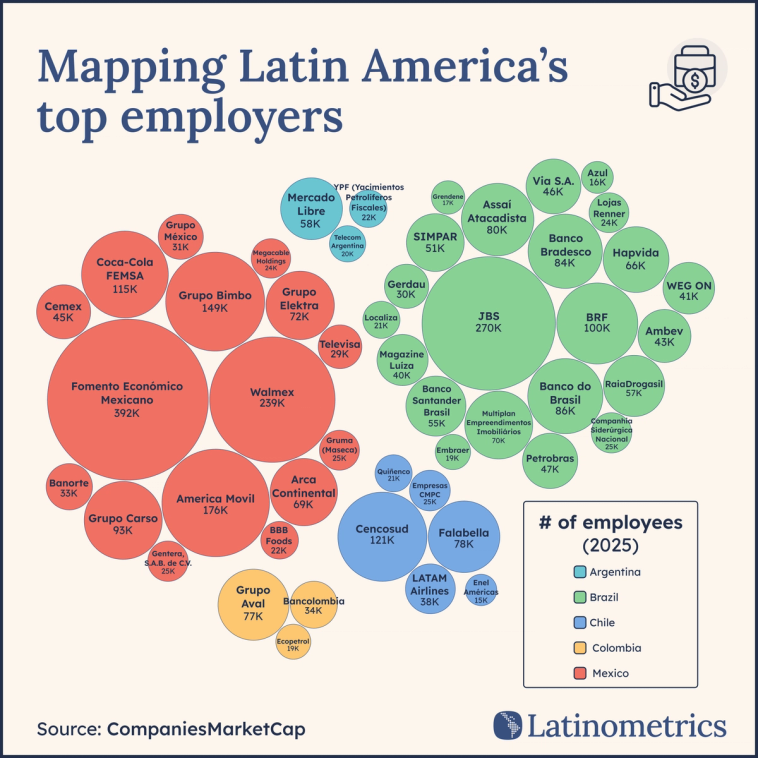
Now, you probably expected Brazilian and Mexican dominance owing to these countries’ size, right?
What may surprise you more is the case of Chile. Led by multilatinas like Cencosud, Falabella, and LATAM, Chilean firms tend to be among the region’s largest, demonstrating the power of successful internationalization and integration strategies.
And notably, these retailers and airlines tend to attract less controversy than some of their counterparts in the rest of the region. Just ask Mr. Batista.


