
A cheeseburger costs 3x more than 5 years ago
McDonald's cheeseburger prices tripled, showing fast food inflation's shocking impact.

If you've been following the news closely for the past four years, you've heard the word "inflation" countless times. Surprisingly, Latin America (with a few notable exceptions) has fared comparatively well in that regard, thanks to what economists call "conservative monetary policy," or, in other words, central banks taking appropriate measures to curb rising prices in their respective countries.
In the US, an excellent way of measuring inflation is through the price of fast food. Why? For starters, one in three people in the United States eats fast food daily, and the industry is worth $330B annually (that's somewhere between the GDPs of Chile and Colombia).
Price increases of, say, a McDonald's cheeseburger can be a good reflection of overall inflation. After all, there's a reason The Economist developed the now-famous Big Mac Index, which tracks the overvaluation (or undervaluation) of currencies worldwide.
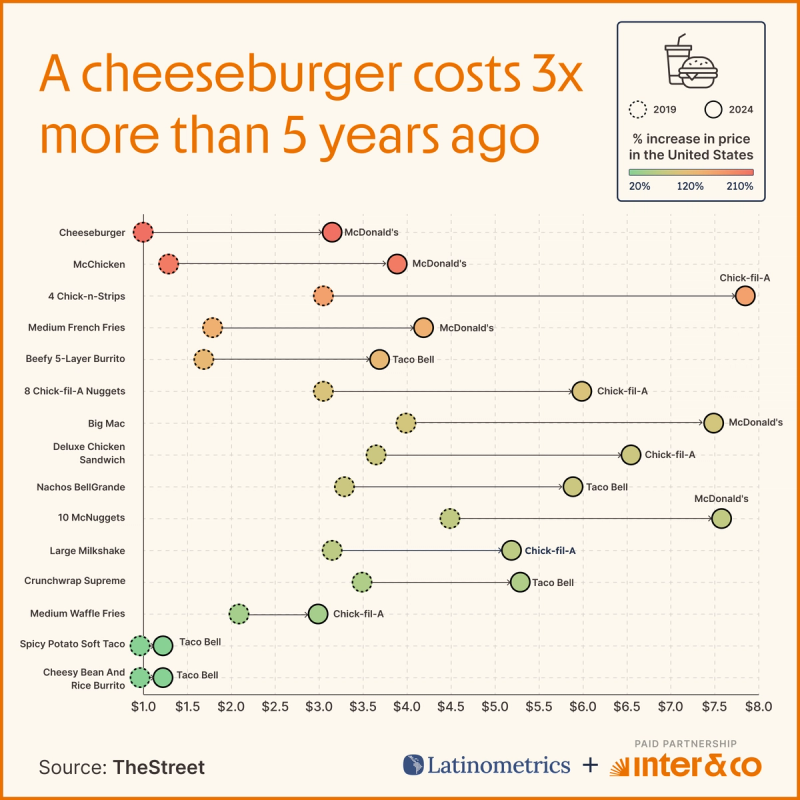
In this case, we're looking at the prices of some fast food staples, such as McDonald's, Taco Bell, and Chick-fil-A, right before the pandemic and now. Perhaps the most shocking trend is that six of the fifteen menu items on our chart have more than doubled in price in less than four years.
The food items on our chart are ordered from highest to lowest % increase in price. You'll notice that a McDonald's cheeseburger takes the inflation trophy — from $1 to $3.15 — with more than triple the price than at the end of 2019.


