
🏎️ Formula 1
There's a rich history of South American racing superstars.

Next Sunday, in Latin America's US capital, the fourth annual Miami Grand Prix will take place.
Over 57 laps totaling an impressive 308K kilometers, Formula One racers and constructors will compete to show why they're the fastest of the 2025 season.
Will last year's victor, Brit Lando Norris, come out on top once more? Will two-time Dutch-Belgian winner Max Verstappen clinch a third victory? Or is it time for a Latin American to leave their opponents in the dust? After the sad departure of Mexico's Checo Pérez, only one regional prospect remains, 20-year-old Gabriel Bortoleto, who debuted this year.
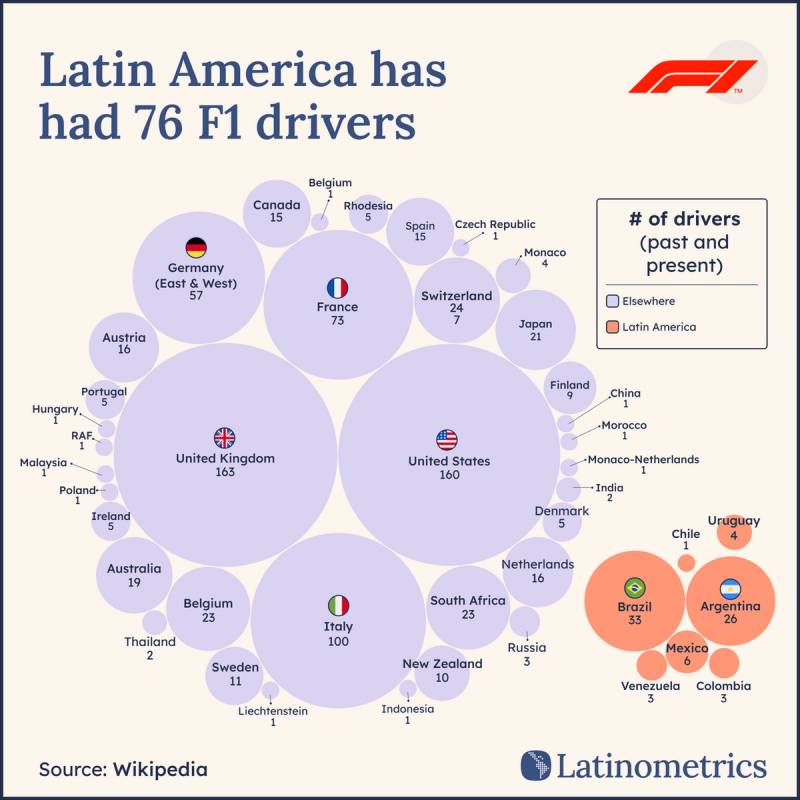
Alas, it's worth noting that Latin America still has a long way to go in terms of F1 drivers. The whole region has cumulatively delivered just 76 drivers in the sport's history, less than half of the figures seen with either the United States or the United Kingdom.
Of these 76, over three-quarters come from just two countries: Brazil and Argentina. Indeed, the same two South American countries that dominate global soccer have also been the best at representing Latin America within Formula One racing.
In fact, you may even have heard of some of these countries' superstars, given they remain among the most celebrated drivers in F1 history.
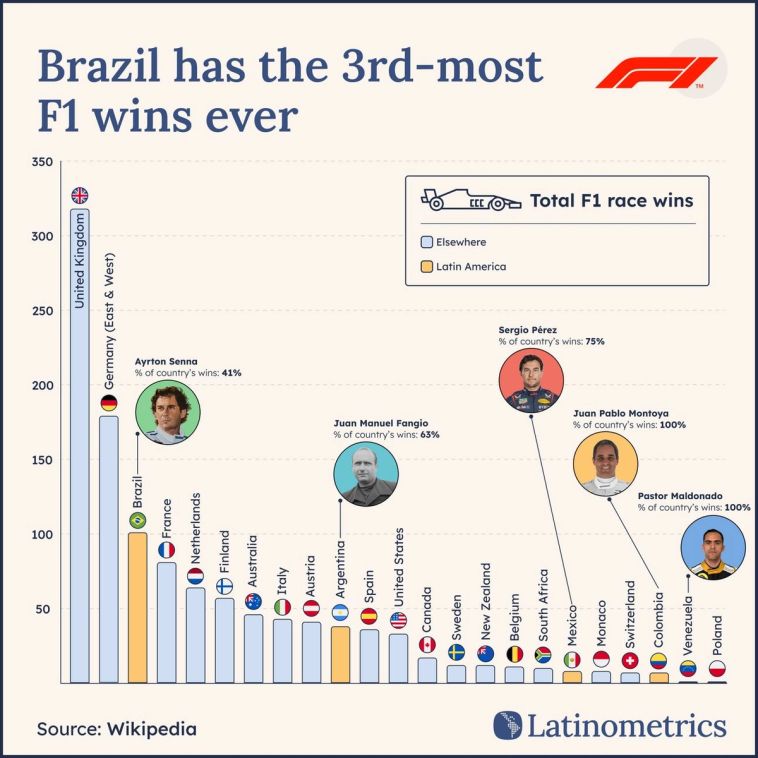
Take Juan Manuel Fangio. El Maestro dominated the first decade of worldwide racing, as he won the World Drivers' Championship an impressive five times—a record which took 46 years, and one Michael Schumacher, to surpass. Schumacher was one of dozens of F1 drivers who recognized Fangio as unparalleled in his greatness.
Another Fangio fan, São Paulo's own Ayrton Senna, won three championships between 1988-1991. So incredible was Senna that, upon his death in a 1994 racing tragedy, his fiercest rival – Frenchman Alain Prost – swore that in his honor, he would never again sit in an F1 car.


