
From Guatemala's Youth to Puerto Rico's 'Elderly': How Old Are Latin Americans?
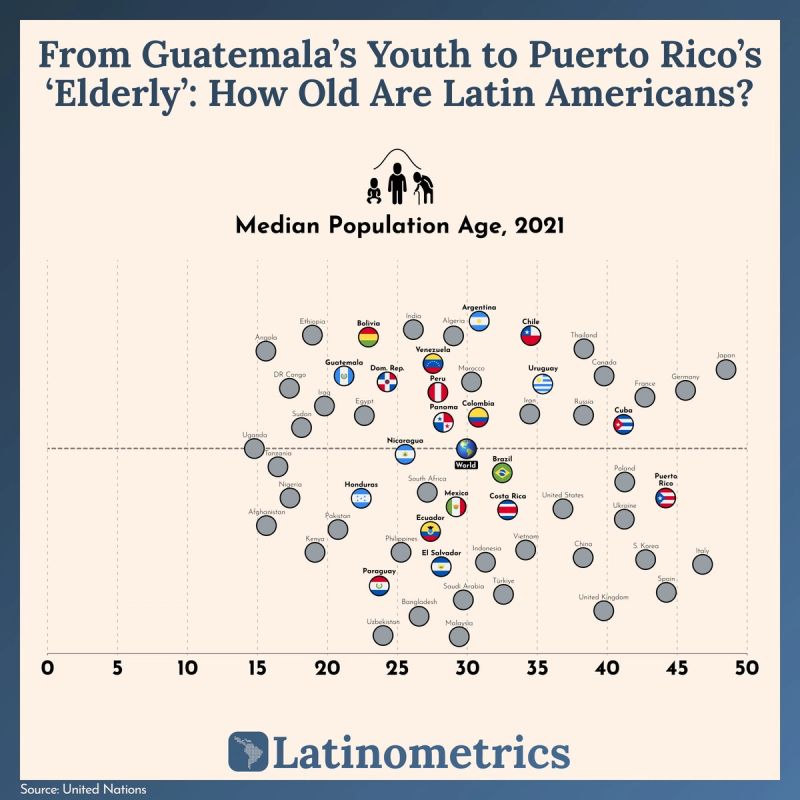
Puerto Rico's median age of 44 outpaces the US, while Guatemala's 22.5 hints at a looming challenge.

Let’s talk demographics.
There’s a traditional logic we see worldwide in which people tend to get older and live longer in wealthier countries, bringing the median age up in these countries. Whether through jokes that the average Italian is of retirement age, or that richer regions more generally look to migrants to keep their economies running, it’s expected that countries further along the development spectrum tend to see higher median ages.
In Latin America, this tracks—for the most part.
Puerto Rico leads the region here by 2021 figures, with the US territory boasting a median age of 44 years that puts in good company with developed European countries like Spain and Germany (and ahead of the mainland US, actually!). Of the countries that follow it in beating the world median of 30 years, some are unsurprising, such as the developed and relatively prosperous democracies of Uruguay, Chile, and Costa Rica. Others – like Cuba or Brazil – may prove more surprising, owing to either their domestic instability or economic concerns.
On the flip side, below the world’s median, we see many countries we might expect. The average Guatemalan, for example, is just over 22 years old, while the average Honduran is just over 23. This puts these countries in the company of developing North African and South Asian states such as Egypt and Pakistan. Notably, none of Latin America’s countries are on average as young as major emerging economies in Africa such as Nigeria or Ethiopia. This may sound good, but there is a bit of a catch.
See, for many of these massive emerging markets the relatively young age of their citizens is a boon, not a downside. While fighting youth unemployment can be difficult, having millions of young, capable workers to power industrialization is vital. Given where Latin American countries such as Argentina and Brazil find themselves today, they’re demographically beginning to reflect developed countries even as they continue to have the income and per-capita wealth of developing countries. Which could be a problem.


