
Gold Reserves in LatAm: Top Holders in the Region
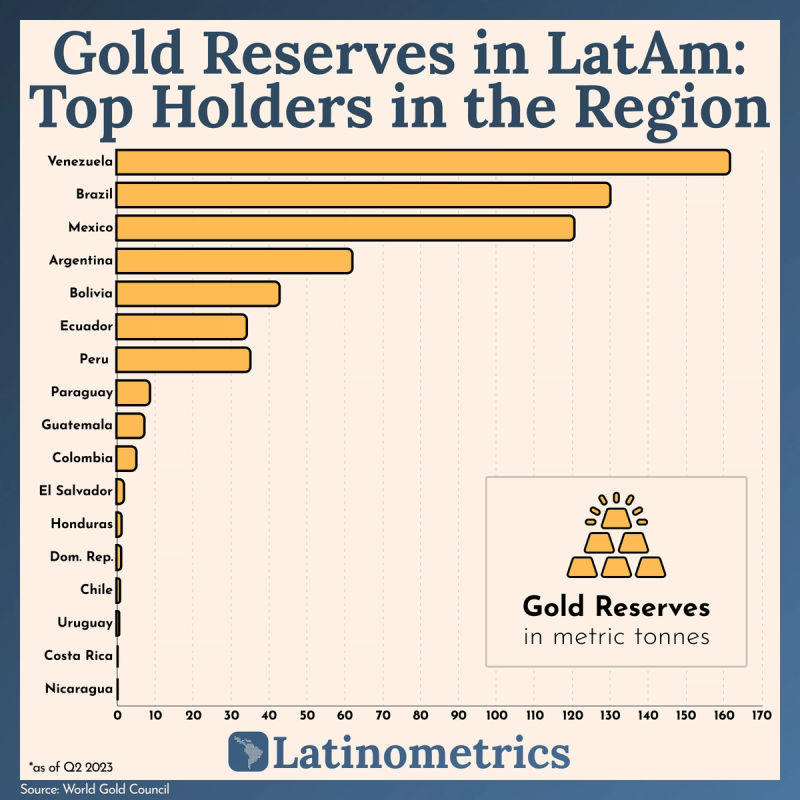
Venezuela's gold reserves dwarf LatAm, fueled by skepticism of Western currencies.


When from time to time former US President Richard Nixon crosses your mind (as he tends to), the Watergate scandal or Vietnam War may be the first events you think of. However, the two-term Republican president actually did something quite notable in 1971 that does not get much attention outside of economist and market-watching circles: he ended the US dollar’s convertibility to gold.
You see, after World War II the major non-communist economies of the world – the US, but also Japan, Canada, Australia, Western Europe, and more – decided to create a global monetary order that would ensure cooperation and prevent global economic stagnation. This system, the Bretton Woods system, led to the creation of the International Monetary Fund and principally governed global monetary policy by pegging other currencies to the dollar, while the US backed every overseas dollar with gold.
Nixon’s decision in 1971, spurred on by wartime troubles and high stagflation, made the US dollar – the world’s reserve currency to this very day – a free-floating currency. This meant that no more did the US need to back up all global reserves in gold, something tough to do given there’s a finite amount gold in the world, and it’s only gotten harder since the 1800s to dig it up.
So why are we talking about all this? Well, this week we’re taking a look at the gold reserves in Latin America’s central banks. This gold is designed to provide a safety net in hard currency unlikely to change in value, in contrast to holding foreign reserves in dollars or euro. It might seem a bit anachronistic to be reliant on gold, but we think it provides an interesting look at how one of the commodities which first made Latin America boom – think of the gold rushes in Mexico or Peru in the colonial era – now sits in central reserves as an insurance policy.
Venezuela leads the way, powered likely by the Andean country’s skepticism of the US dollar or other similar Western currencies, while Latin America’s giants – Brazil and Mexico – follow suit. Argentina’s dried-up foreign reserves have put its gold situation in headlines recently, while we were intrigued to see dollar-denominated Ecuador holding as much gold as it does.


