
High Internet Speed & Access: Essential for Economic Freedom?
With the 3rd fastest internet globally, Chile shows how connectivity boosts economic freedom.

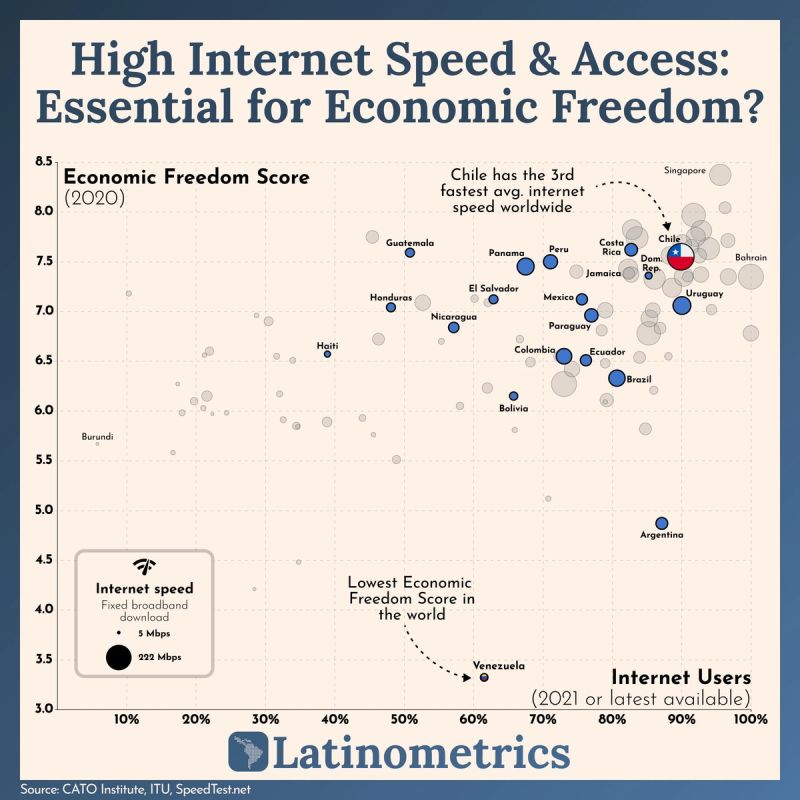
One thing the pandemic definitely reinforced was the vitality of good Internet access. Over the past few years, as the world shut down, people stayed home and businesses went virtual, being able to access or sell goods online made all the difference.
Yet in Latin America, there’s a lot of progress to be made in the ‘digital divide’ in terms of both Internet access and the speed of said Internet—with big implications for economic freedom, or the ability of people to control their own labor and property.
Citizens of Haiti or Honduras, for example, can understandably have trouble running a business or selling products online when fewer than half of them have access to the Internet. Lots of Bolivians, meanwhile, run into a different problem, as those who can connect may only maintain a slow, unsteady access, an especially potent problem issue for the roughly 30% living in rural areas.
There’s also the matter of cost. For just one gigabyte of data, Colombians may be required to spend up to 5x more of their monthly income than is advised by the United Nations. As the local government seeks to close this digital divide, it has joined peers in Argentina and Chile in declaring reliable Internet access an essential public good. This is a promising start for the roughly 3 in 10 people across the region who lack Internet access—just ask local students who had to tune into COVID-era classes through parents’ cell phones or radios.
Chile’s public and private sectors have also successfully partnered to bring some of the hemisphere’s fastest Internet speeds to over 90% of the population, even in remote rural areas like the country’s south. It unsurprisingly boasts one of the highest economic freedom scores in Latin America, along with the world’s 3rd fastest internet speed, a testament to how boosting connectivity can leave citizens with better agency in their financial futures.
Access to cheap, reliable, and speedy Internet won’t solve all of Latin America’s problems. After all, the abysmal state of economic freedom in Venezuela reflects a combination of factors, some economic and some political. But greater connectivity, by keeping students in school and e-commerce flourishing, can provide another means of tapping into Latin America’s potential through its strongest asset: people.


