
The drops and surges of LatAm homicide rates
While LatAm's homicide rates fell between 2019-2023, Ecuador saw a 700%+ surge.


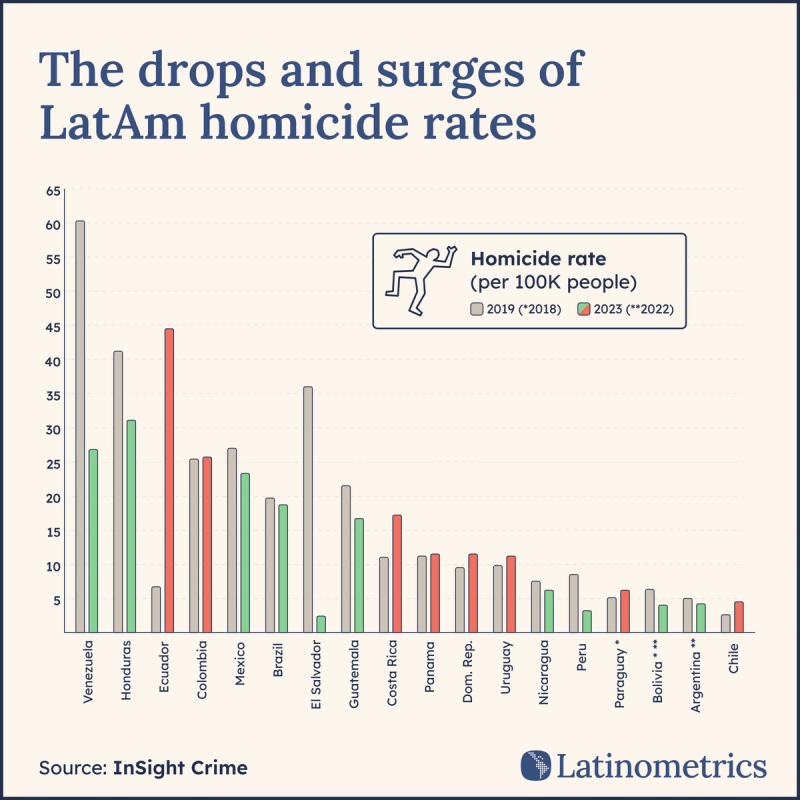
There's been progress in fighting killings across much of the region. But some countries have seen a deterioration in recent years.
Rio de Janeiro is without a doubt one of the most beautiful cities in the world. The culture, natural landscapes, and architecture has brought it international recognition and renown for over a century—in fact, the city is even a UNESCO World Heritage Site.
So why is it that if you tell anyone, even Brazilians, you’re going to Rio they’re likely to shudder and caution you about the danger?
The truth is, as always with these sorts of things, a mixture of truth, legend, and exaggeration. Rio, like many other big Brazilian state capitals, has had a long history of severe crime and violence. However, in recent years the city has grown substantially safer in many parts, to the degree where some cities with better reputations actually see higher incidence of crime.
Which is to some degree the story of Latin America overall. The region has long been plagued by violence in both its cities and its countryside. For some areas in particular, such as Colombia, Mexico, or the Northern Triangle of Central America, this has been true for decades.
But this doesn’t mean there hasn’t been progress. Latin America’s two largest countries, Brazil and Mexico, each saw decreases in their homicide rates between 2019 and last year. This has also been the case for other historical hotspots like El Salvador, Honduras, and even Venezuela.
Now for the negative: for many of the countries which outperformed their peers in decades past, the last few years have seen the reverse trend, with homicides per 100K people going up. And nowhere has this been more true since 2019 than Ecuador, which has seen over a 700% increase in its homicide rate in just a few short years.
Led by the disasters seen in cities like Guayaquil, Ecuador is today facing much of the senseless violence and instability historically reserved for countries like Colombia and Mexico. Its position as an oasis of peace in an otherwise bloody Andean region is shattered, and it’s not the only country where citizens feel this way.
Crime was front-and-center for citizens voting in recent Argentinean, Chilean, and Panamanian elections, and it’s looking similar for this year’s Uruguayan presidential race. The region has made some progress in lowering homicide rates—but there remains much work to be done.


