
How Much Money do Latin Americans Abroad Send Home?
El Salvador's economy relies on remittances for 24%, while Mexico's diverse economy keeps its share at 4%.

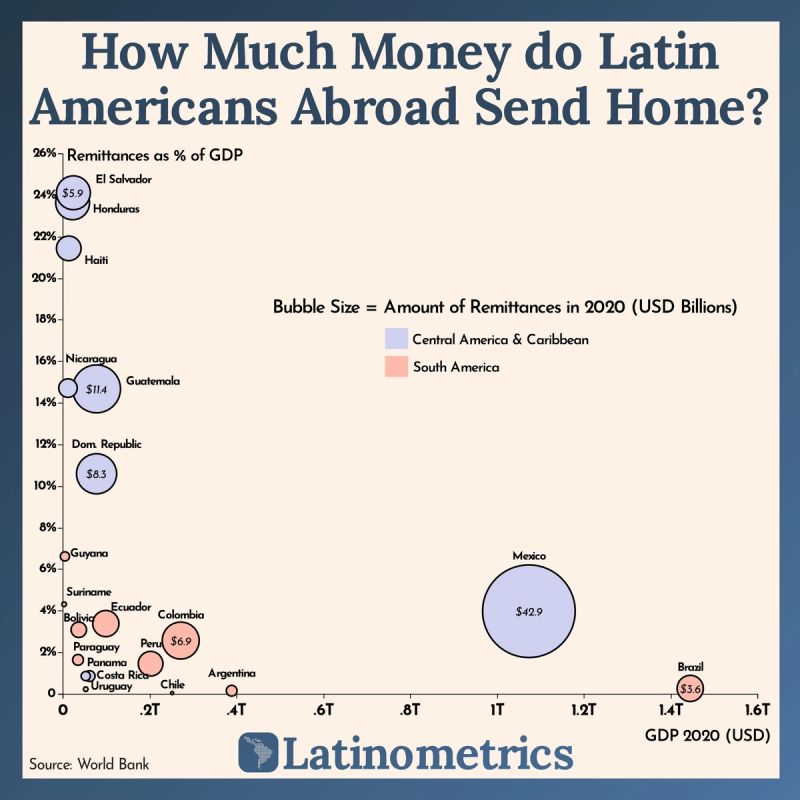
Remittances or “remesas” are payments sent from people earning an income abroad back to their home country. There’s an admirable quality to the act of sending remittances. These payments are often sent from hardworking people in the US to support their communities and families.
You’ll notice a trend in this chart: for the most part, countries farther south from the US receive a lower share of remittances in terms of their GDP. In fact, 24% of El Salvador’s economy consists of remittance payments.
The most notable exception to the trend is Mexico. Despite receiving an astronomical $42.9 billion in 2020 and being the closest neighbor to the US, it receives remittances that account for only 4% of its GDP. That’s because the country has a diverse economy that pulls its weight through industries like manufacturing, petroleum, and tourism.
All combined, the countries on the chart received a total of almost $100B in 2020. For 2021, the World Bank reported a 21.6% increase in the region.
Editor’s note: In 2022, the World Bank reported a 9.3% increase in the region, in line with a larger economic slowdown, given the growth was less than half of 2021’s.
The truth about Costa Rica's pesticide use
A key quote from the article:
Despite the recognized fact of the risks that the use of synthetic chemical substances pose to health and the environment, their number, far from diminishing, is increasing. … Costa Rica imports 12 million kilograms of active ingredients annually.


