
How Much of LatAm's Workforce is in Agriculture?
LatAm's farm workforce dropped from 21% to 14% since 1991, but output doubled. Efficiency is key.

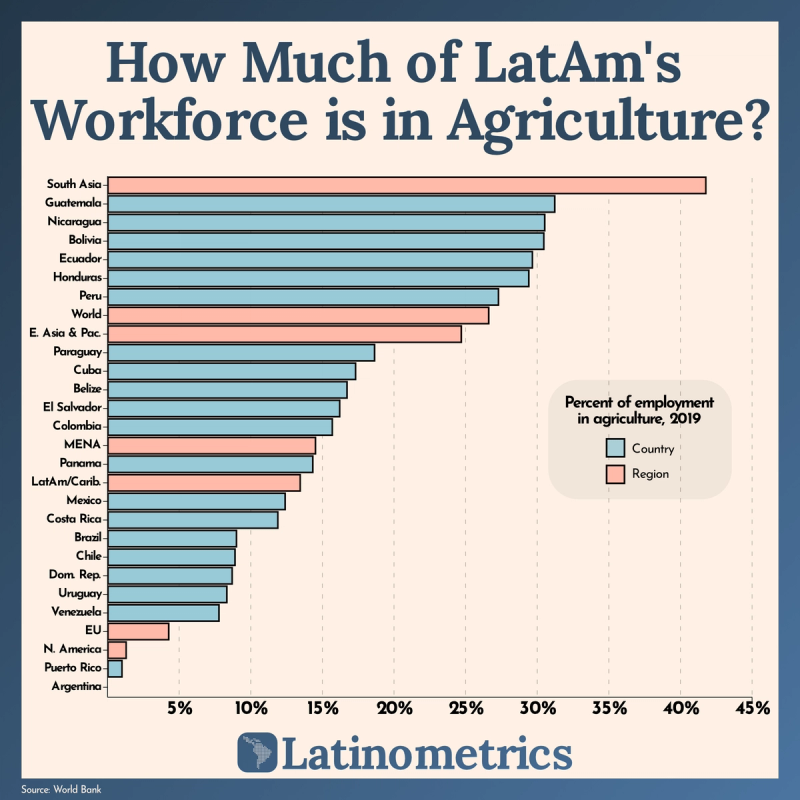
Since 1991, when the World Bank began reporting countries' share of employment in the agricultural sector, the world's percentage has dropped from 44% to 27% in 2019. Latin America has had a surprisingly lower rate than the world's average in that same period — from 21% to 14%. Here's what's interesting: agricultural output since 1991 has expanded by more than double.
How? One word: efficiency. As countries and technologies develop, agriculture becomes more automated, and there is less need for people to participate. Populations become more service and technology-oriented, moving into urban areas. Rich countries generally have a much lower share of their populations working in agriculture; for example, North America's share (excluding Mexico) is only 1.4%.
There are two extremes in Latin America — Guatemala, with a rate of 31%, is the region's most agricultural country. Its population is scattered across rural areas, and its economy largely depends on its farmland, which is one of the top world producers of cardamom, bananas, and coffee.
On the other hand, Argentina's agricultural employment rate has been below 1% since 1991. Land laws and industrialization have allowed land to be concentrated in fewer hands, with few specialized farmers producing the entirety of the country's output, which has actually been increasing over time.


