
How much do Mexico’s banks make on their equity
How does Mexico's banking sector compare to the rest of the world's?


Mexico’s five largest banks control two-thirds of national banking assets, but that’s not extreme. After all, over 100 countries have even tighter concentrations, including developed markets like Germany (94%), Finland (96%), and Hong Kong (73%).
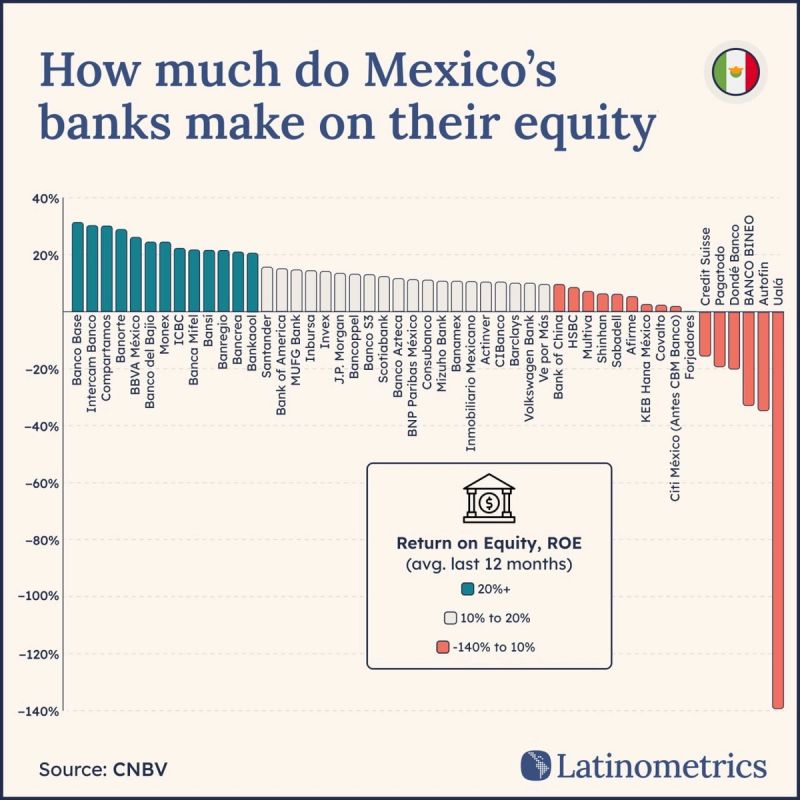
Today, instead, let’s look to equity, meaning specifically the money belonging to each bank’s shareholders. Mexico’s banking sector shows high average ROE, roughly 18%, which beats its counterparts in the United States, European Union, and every Latin American peer except Guatemala and the Dominican Republic.
Of course, ROE does not always denote banking strength—after all, Syria, Kazakhstan, and Zambia lead global rankings, indicating the role of market distortions and risk premiums.
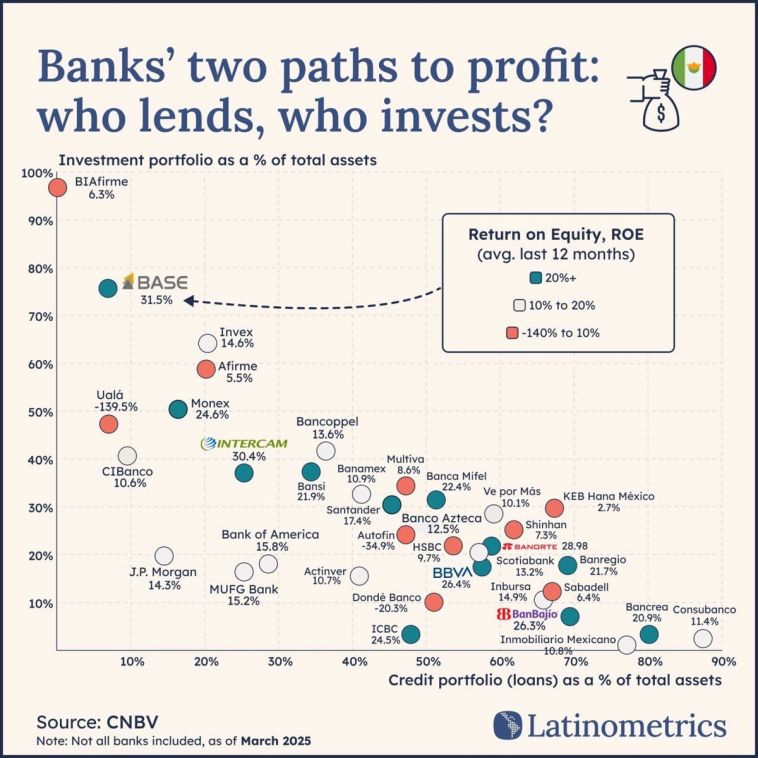
Banco Base, surprisingly, has just 12% of its assets in loans, and 70% in investments, in the process earning over 30% ROE. This pure investment-driven model lets the bank thrive without growing its credit risk—an alternate path to the one upheld by classic giant lenders like BBVA and Banorte, which leave 50-70% of their assets in credit and subsequently achieve over 20% ROE.
On the flip side you’ve got Ualá, an ambitious fintech originating in Argentina which has thus far struggled to adapt to the capital demands of full banking in Mexico. Despite its backing by hundreds of millions of VC dollars, Uala has seen limited lending and an abysmal ROE of -139.5%.
So what did the company get wrong? In the age-old debate of capital allocation, where should banks be putting their (and your) money to maximize their returns?
Now, household debt in Mexico equals just 16.3% of the gross domestic product (GDP), landing the country in the bottom 15 worldwide. To give you an idea, the US has 72.9% household debt, while Germany has 51.3% and Brazil 34.9%. Mexico has long been known for its cautious credit culture and preference for government securities or cash over aggressive loans.
Evidently, each bank will chart its own course, with a few key factors to consider. The first is the fintech element—with 800+ of these firms and 20% annual growth in the industry, these neobanks are pushing into traditional sectors and putting pressure on the historic giants.
Finally, there’s the national considerations of any market. In Mexico, banks operate in a high-rate, low-competition environment, one which yields fat net interest margins (5-6%) that are harder to find in markets like the US or EU.
Do Mexico’s biggest players need a strategy overhaul? Or to stay the course?


