
Where have job markets surged in LatAm?
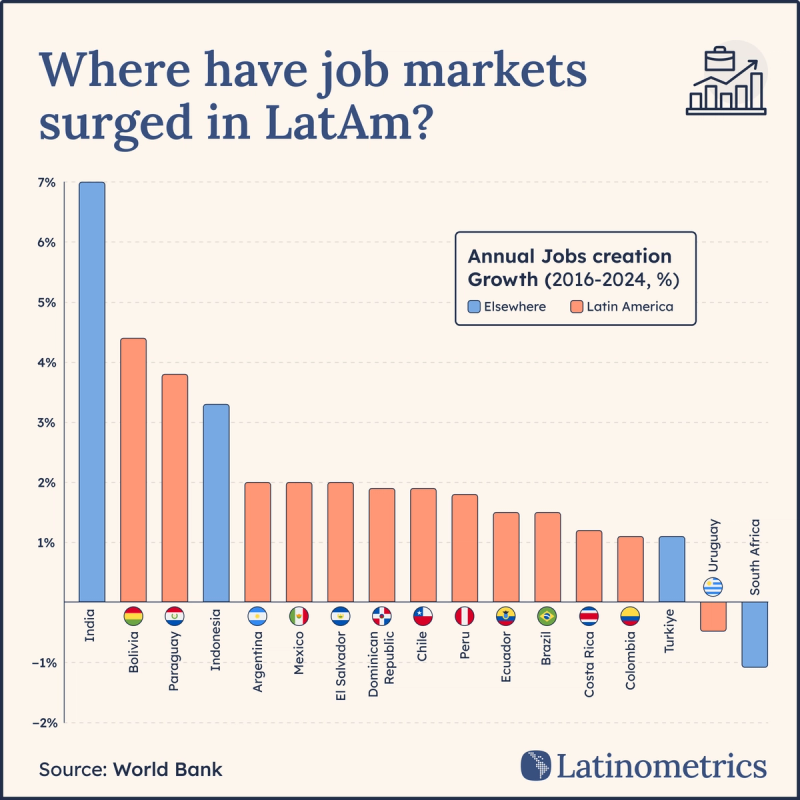
Bolivia leads LatAm with 4%+ annual job creation since 2016; Mexico lost 2M jobs in 2020.

Lack of economic opportunity has long been oneo of the top reasons people leave Latin America and the Caribbean. Just a few years back, UN Migration’s regional bureau noted that over 60% of survey respondents had cited economic-related concerns such as informal job capacity or minimal job advancement as the reason behind their migration.
Yet for millions of Latinos staying in the region, the last decade has still seen job growth on the backs of international investment and development. Interestingly, Bolivia has led the charge with over 4% annual job creation since 2016. Bolivia is followed closely by Paraguay, which has become in recent years a bit of an investor haven, and the two hearts of South America far outperform their neighbors and regional peers by the metric of job creation.
For most of the rest of the region, growth has been a bit more sluggish, falling somewhere between 1-2% annually. This can be partly explained by economic crises which have gripped different countries in the region at different times, including Brazil (2016-2020) or Argentina (2018-present).
Of course, the COVID-19 pandemic which falls halfway in our period of study also plays a role. The pandemic was particularly harsh in Latin America and regional job markets felt the blow.
For example, total employment in Mexico dropped 3.7% (or 2M jobs) between March and December 2020 as entire sectors of the economy shut down and workers, particularly women, were laid off.
Now, not all jobs are created equally. Many of the countries which have seen the lowest annual job creation since 2016, such as Colombia or Uruguay, have also had the highest jumps in annual wages in that same time period.
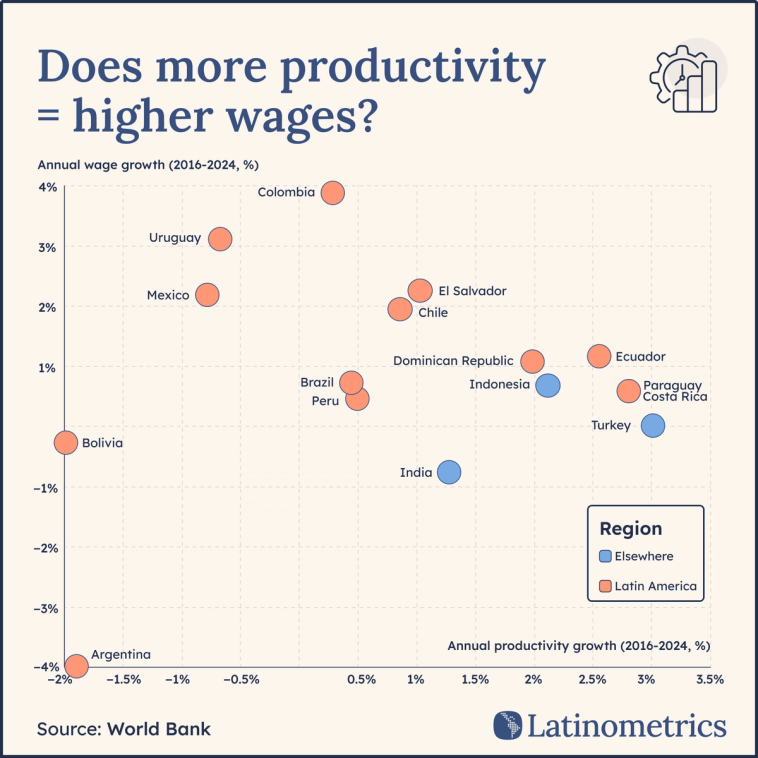
Meanwhile, other countries have reaped another key benefit of international investment: productivity growth. Small, investment-friendly countries like Costa Rica, Ecuador, Paraguay, and the Dominican Republic have been the big winners by this metric, with annual productivity growth of over 2% and therefore workers which are increasingly attractive to foreign businesses.
As we don’t have reliable data for Venezuela, it’s Argentina who is our sad story today. With currency devaluation, economic crisis, drought, and a smattering of other macro issues, Latin America’s third-largest economy has seen losses in both annual wage and productivity growth.
Reversing these losses to catch up to Argentina’s neighbors will no doubt need to be a key priority for the recently-bolstered Javier Milei administration.


