
"La Reconquista Silenciosa": Texas is the 3rd State to Become Majority Latino
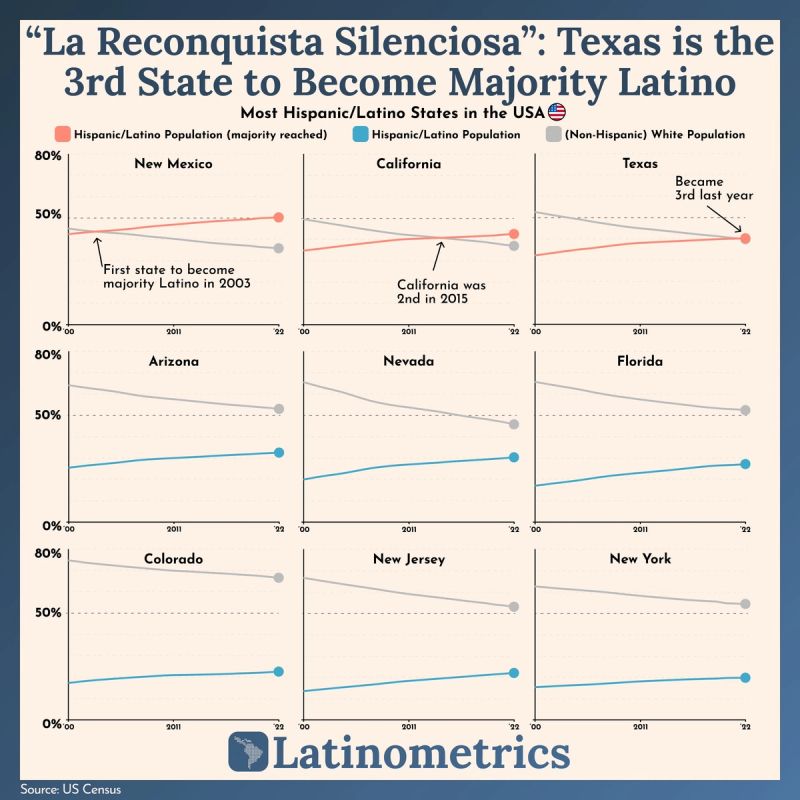
Texas is now a majority-Latino state, 155 years after the US-Mexico war.


Between 1846 and 1848, the US and Mexico fought a territorial war, resulting in the US annexing more than 40% of Mexico's entire land. Mexico was not even 30 years old as an independent nation, and the USA had an ambitious expansionist agenda. Some in the country, including the then president, James Polk, followed a "manifest destiny" ideology: the belief that US settlers were destined to expand across North America by virtue of their superior moral and cultural values.
Expansionism lessened in popularity as influential historical figures like Abraham Lincoln and John Quincy Adams repudiated manifest destiny.
The territory that was once Mexico includes parts of most of the states on our chart. Florida, New Jersey, and New York are the only exceptions.
Ironically, 155 years after the US-Mexico war, New Mexico has a predominantly Hispanic population. By 2021, Hispanics accounted for half of the state's population. To taste Mexican heritage in the state, you can visit South Valley, NM, or Española, NM, where 80%+ of the population is Latino.
Since the start of this century, the two largest states in terms of GDP, California and, most recently, Texas, have also evolved into Latino majorities. This demographic has been the fastest-growing in the country for two key reasons: first, a large wave of migration from Latin America that started in the 1970s, and second, a higher-than-average birth rate by Hispanic women and families.
In 1980, only about 6.5% of the population was Hispanic. Last year, that percentage was almost triple — 19.1% and it's the second most common demographic after White. The culture has become an essential part of the country, which is the 2nd largest Spanish-speaking in the world.
The manifest destiny motivations of the past have given way to a place where countless cultures co-exist. The past war, modern migration, and prosperity have created a culturally rich country rather than one shaped by a single "destiny."


