LatAm ETFs are Outperforming the S&P 500 This Year
While the S&P 500 plummeted 16% YTD, LatAm ETFs thrive, thanks to fewer tech stocks.

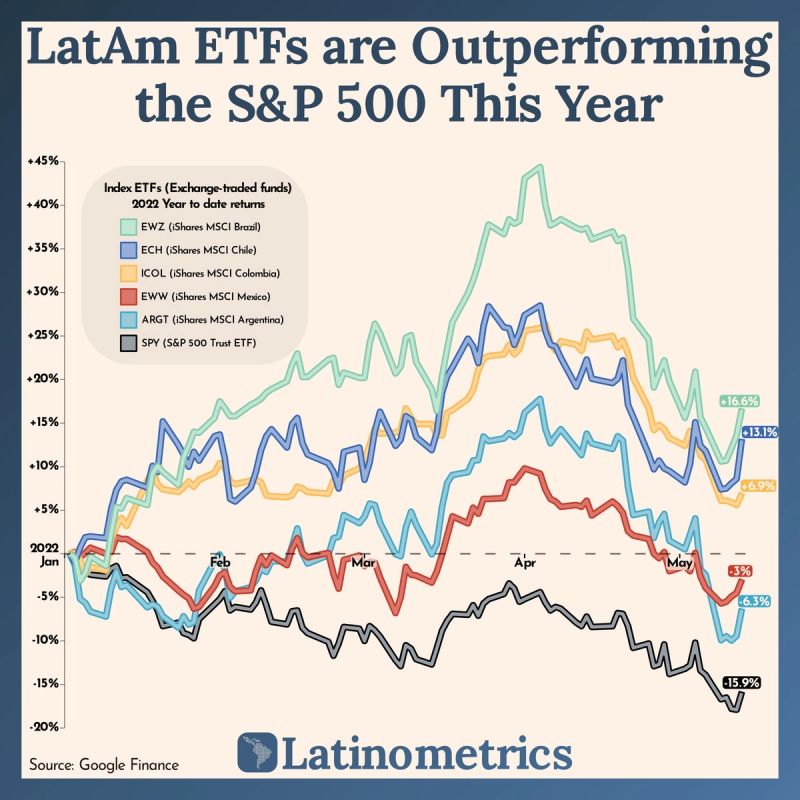
The S&P 500 (SPY for short) is the gold standard for stock investors. SPY, maintained by Standard & Poor’s, is an ETF that tracks 500 of the US’s largest publicly-traded companies. Several books study how simply investing in the SPY often outperforms the so-called experts on Wall Street, especially in the long term (we recommend ‘A Random Walk Down Wall Street’ for investment advice). If you’d invested $1,000 into the S&P 500 10 years ago, your money would now be worth $3,147 — a 215% return. Keep in mind that the SPY outperforms every single one of the ETFs on our chart in the long term as you read along.
This year has so far been hard for most financial markets. In just five months, the S&P 500 has plummeted 16%. Other sectors have fared much worse; Cathie Wood’s ARKK ETF, which tracks ‘high-growth’ technology stocks like Tesla, Roku, and Zoom, is down 56% year-to-date (YTD). That’s quite the fall from grace from 2020 when the pandemic and bull market were rampant — that very same ETF was up ~200%. As the pandemic gains are virtually erased, many of the technology stocks that once soared are now being called ‘meme stocks’ or ‘pandemic stocks.’
MSCI’s LatAm ETFs have been thriving amidst all the crashing. These ETFs track some of the most notable publicly-traded companies in different countries. For example, the Brazil ETF tracks Vale and Itau, while the Chile ETF tracks Banco de Chile and Enel, among many others. All of LatAm’s top 5 economies that MSCI tracks are outperforming the S&P 500 this year. We think this is most likely because the sectors behind these LatAm ETFs, unlike the US economy and the S&P 500, are composed of fewer technology companies, which are suffering right now. These ETFs track more banks and energy companies, which often have a solid financial footing.
The public market is now looking for companies with ‘good fundamentals’ — a phrase you might hear a lot in the coming months. Investment in private startups is another market in which investors are now warier, limiting their bets to profitable business models or companies that are not burning through immense amounts of cash.
*This is not investment advice