
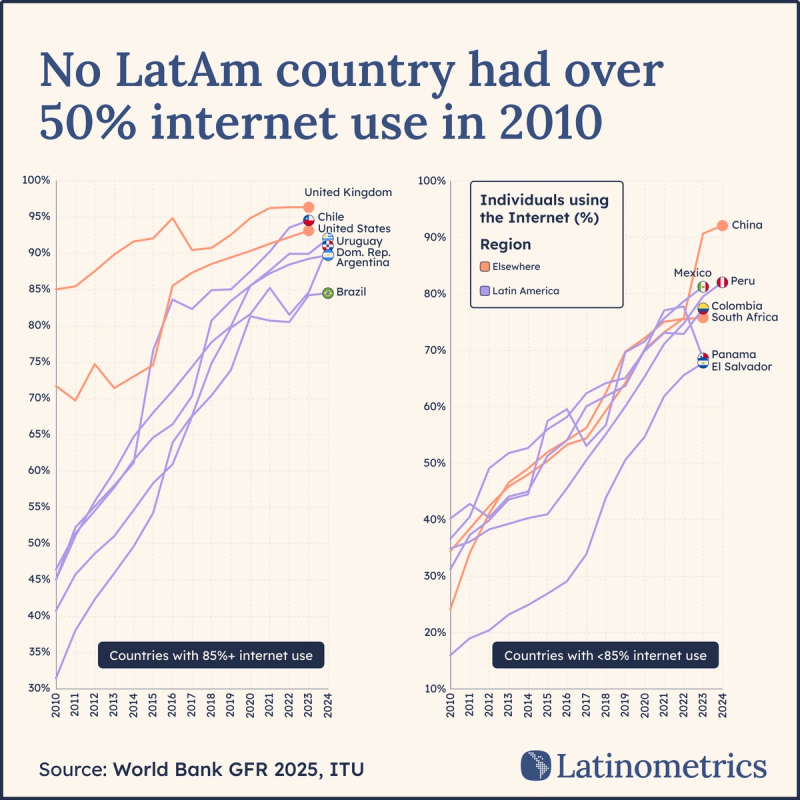
No LatAm country had over 50% internet use in 2010
More Brazilians use Instagram than live in Mexico or Russia, but 1 in 10 LatAm adults still lack internet.

Here’s a fun fact for you: at over 147M users, there are more people on Instagram in Brazil than in the entire population of either Mexico or Russia.
From there, about 109M Brazilians are on Facebook, and an additional 91M or so are on TikTok.
Brazilians have taken to social media more than basically any other Latin American country. Yet fifteen years ago most wouldn’t have been able to even log on to such a site.
The 2010s saw Latin America get connected and in a big way. In just a decade and a half, countries across the region made huge strides in growing connectivity for their citizens, led by private-sector and public-sector cooperation.
Today the percentage of Chileans with Internet access is higher than its US counterpart. Not bad, especially given that in 1995 only 0.04% of the world had (dial-up) Internet access—and over half of those people were living in the United States.
Across the region, Internet access tends to be fairly high and growing rapidly. Innovative new international options like Starlink have bridged gaps in many more isolated regions, competing with established telecom giants like Telefónica or América Móvil.
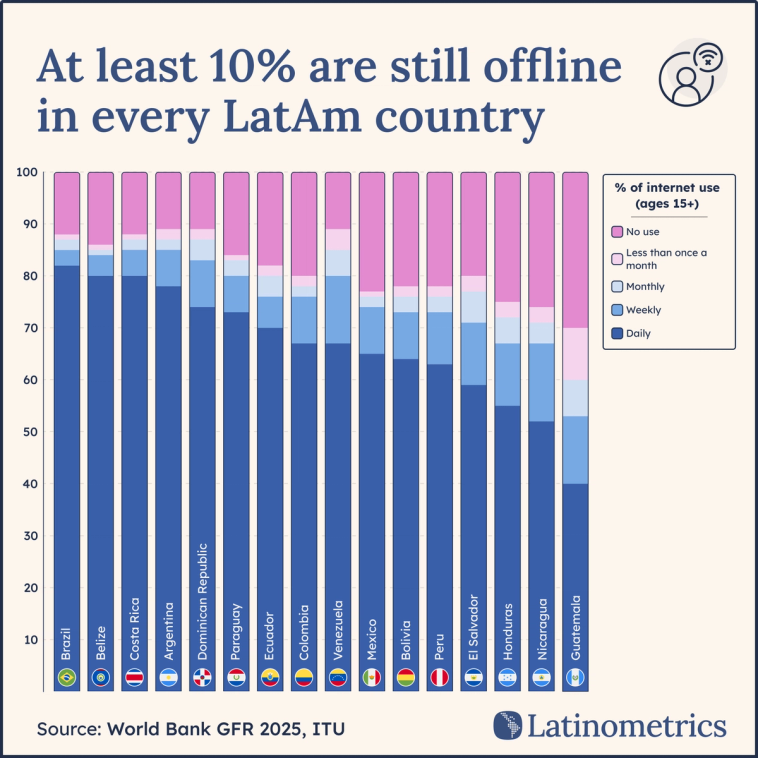
Which isn’t to say everyone has been brought for the ride so far. At least one in ten Latin Americans across the region still lacks reliable Internet access. In some countries, it’s even worse.
For example, Nicaragua and the Northern Triangle countries of El Salvador, Guatemala, and Honduras persist in having the largest Internet gaps. In all four Central American countries, at least a fifth of the national 15+ population has gone longer than a few weeks since they last used Internet.
Contrast this with countries like Brazil, where over 80% of the adult population is using the Internet daily. This goes far beyond mere social media or news usage, though, as it also includes the billions of Pix payments sent each day in Latin America’s largest country.
From Pix to e-commerce to so much more, Latin America’s future is certainly on the web. Happy surfing!


