
LatAm's Agricultural Trade Surplus: Fueling Global Food Markets
LatAm's $150B agricultural surplus keeps the world fed, with Brazil fueling global markets.


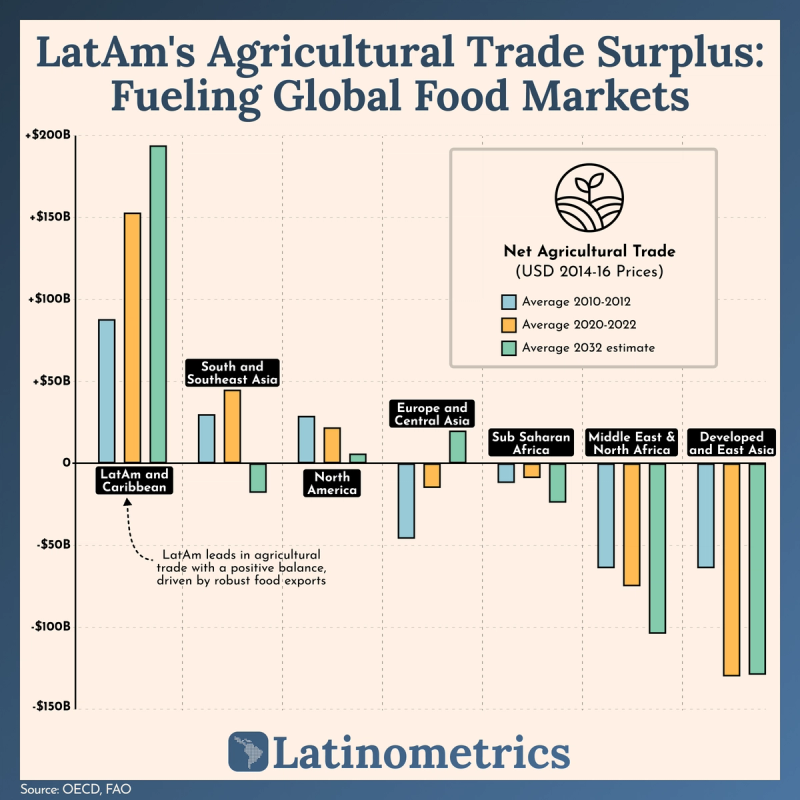
Let’s call it like it is: looking at the above chart, the world should be pretty happy Latin America is around.
Yes, our favorite world region has by far the largest positive trade balance in agricultural goods globally. With a 2020-2022 average of $150B, Latin America & the Caribbean represents the counterweight to regions such as East Asia and North Africa which are particularly import-heavy when it comes to agriculture.
Food is especially the main story here. As we’ve mentioned before, Latin America produces over half of the world’s soybeans, with three of the largest producers globally – Brazil, Argentina, and Paraguay – falling in the southern part of South America. A lot of this soy goes straight to the world’s largest import market for the crop, China, explaining in part the figures you’re seeing on our chart.
Brazil in particular is of note, being the largest source of soybeans, sugar, poultry, coffee, and corn (the last of which only occurred fairly recently). Considering second-hand agricultural products such as livestock, Brazil is the also the world’s second-largest beef exporter (following the United States), and the country plays a large role in sustaining the halal beef markets of the Arab world.
Meanwhile, our beloved Argentina has historically been known as the breadbasket of the world owing to its status as an essential agricultural producer of maize, barley, cereal, wheat, and soy. The Pampas region in particular is considered of note, though severe droughts in recent years have been damaging for output.
Latin America may today be the breadbasket of the world owing to its fertile land, great climate, and strategic location, but don’t think that’ll change soon. In fact, in the next decade it’s expected that the region’s trade balance will balloon to nearly $200B as demographic changes and global population growth boosts the demand for foodstuffs.
For now, it’s safe to say that the region is vital to global supply chains. As billions of people join the emerging middle class worldwide, it’s evident that Latin America will play a central role in keeping people fed and keeping agricultural trade humming.


