
LatAm's GDP Per Capita Trails China's But Vastly Exceeds India's
LatAm's GDP per capita has stagnated, trailing China but vastly exceeding India's $3K per person.

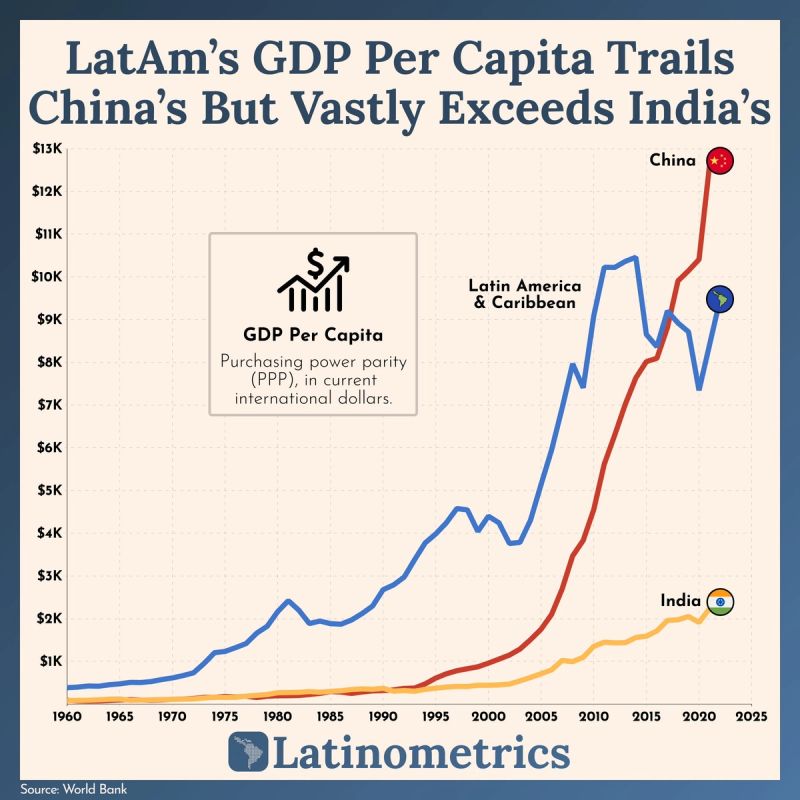
And Latin America overall has done quite well for itself in the past century, particularly when compared to other developing regions worldwide. It’s only in recent years that per-capita gross domestic product (GDP) has stagnated, with major recessions in Brazil, Argentina, and Venezuela since 2014 doing their part to drive the decrease.
Contrast this story with China, which as late as the turn of the century had a per-capita GDP numbering at less than a quarter of the Latin American average. Between 2005 and 2015, the East Asian superpower closed the gap and even surpassed Latin America by this metric.
However, it is worth mentioning that, as we’ve discussed before, China’s runaway economic success and massive domestic demand powered Latin America’s golden decade in the 2000s, explaining in part that huge increase seen in the region between 2003 and 2014.
Furthermore, the result does depend a bit on the comparison. We mention China given last week’s look at the world’s largest economies, but the other major emerging Asian superpower, India, has quite a ways to go to catch up with Latin America. India’s GDP today, when divided up by its staggering population (the world’s largest), shakes out to less than $3K per person—far below the nearly $10K seen in the Latin American average.
Finally, we do want to raise the question of distribution. Dividing a country’s GDP by its population may be effective in giving a rough overview of how it’s faring, but it doesn’t take into consideration inequalities which may keep most of the wealth concentrated in only some hands. Trying to keep this in mind while also reversing the past decade’s poor performance won’t be easy, but it’s necessary all the same.


