
LatAm's Oil Production: Mexico's Dominance, Venezuela's Acute Fall, and Brazil's Rise
Mexico's oil output peaked in 2004, but Brazil's production grew 13x since 1980.

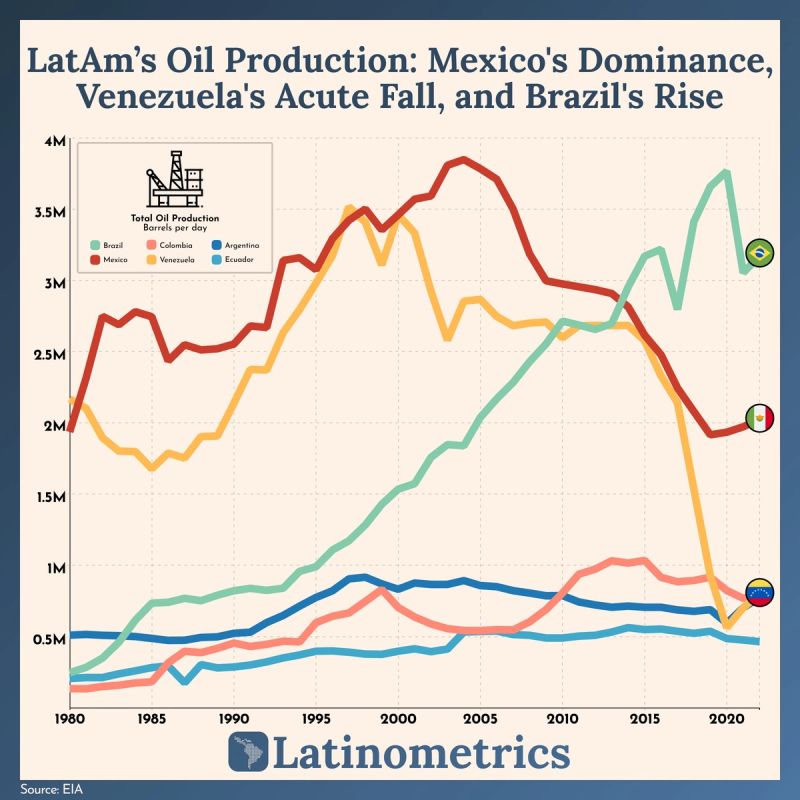
Mexico is the historic giant in this industry, spending much of the past century serving as Latin America’s major player in oil. The country boosted exports throughout the 1980s and 1990s, though production peaked in 2004 and has faced a long decline ever since. In fact, today the US state of New Mexico actually produces more than Latin America’s 2nd-largest country.
While Mexico has seen decline in its oil sector amidst instability and political interference, this is nothing compared to Venezuela. The country with the world’s largest oil reserves has seen a classic case of the resource curse as it has devolved from the region’s richest nation to an economic catastrophe wracked by hyperinflation and crisis. The many missteps of the current Venezuelan regime, in power more or less nonstop since 1998, have only deepened the country’s abysmal production levels of (and overreliance on) petroleum.
If there’s one major success story in the last few years which has capitalized on its peers’ failings, it’s Brazil. Latin America’s giant has soared to become the region’s largest oil producer and exporter, taking advantage of a number of successful and valuable oil deposits off the coast of Rio de Janeiro and in the Amazon basin. Even major scandals have not stopped 1980s figures from growing by 13x between 1980 and today under the hands of state-owned oil firm Petrobras.
Today Latin America’s oil powerhouses must certainly reckon with the role of the energy commodity in their economies. Colombian President Gustavo Petro wants to stop all further oil exploration in his country, while Ecuador’s citizens voted in September to block drilling in a protected natural preserve in the country’s east.
However, with the US lessening sanctions on Venezuelan oil and Brazil proceeding with plans to drill in the Amazon, it’s clear that this controversial commodity is here to stay in the region—at least for the time being.


