
Latin America's Major Multilateral Bank: Credit Portfolio Distribution
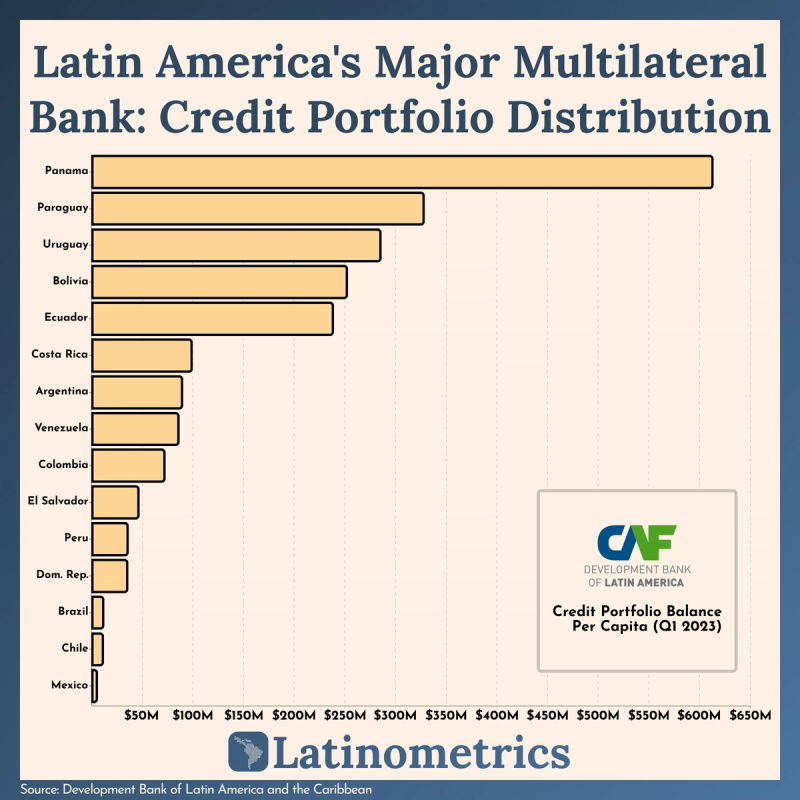
Panama leads LatAm's multilateral bank credit, holding roughly $1.6B per capita.

We’ve written about development finance through institutions such as the Inter-American Development Bank (IDB) before, but the CAF was different from its founding. After all, this was a development bank set up by and for Latin American countries. The amounts may be smaller, but this was an institution designed to be kept within the family, so to speak, which is why the major shareholders currently include the same founding members (with just Bolivia replacing Chile).
Today the CAF – Development Bank of Latin America and the Caribbean has become a nearly 20-member institution, spanning all of Latin America’s largest economies and three Caribbean countries (besides the Dominican Republic). The only two non-regional member countries are the associated members of Spain and Portugal, notable for their linguistic and historical connections with Latin America.
Last year, the CAF approved 305 operations worth a total of $14.1B, representing a 6.9% growth in approved financing for 2021. While this may be less than secured by established institutions such as the IDB, it does reflect a multibillion-dollar effort to ensure funds for the region’s sustainable development, productive infrastructure, and the energy transition.
And the good work continues: this year has seen a number of borrowing countries financing their long-term development strategies with CAF funds. For example, we highlight above the roughly $1.6B in per-capita capital balance held by Panama, Paraguay, Uruguay, Bolivia, and Ecuador. These smaller regional economies represent just shy of half the total credit portfolio balance.
Development finance can be tricky to secure and trickier to get right. But with regional initiatives like the CAF, Latin America can harness the necessary capital to fund its future growth.


