
Latin America's Trade Balance, Visualized
US-China trade with LatAm topped $1T, but regional trade barely hit $165B despite 650M people.

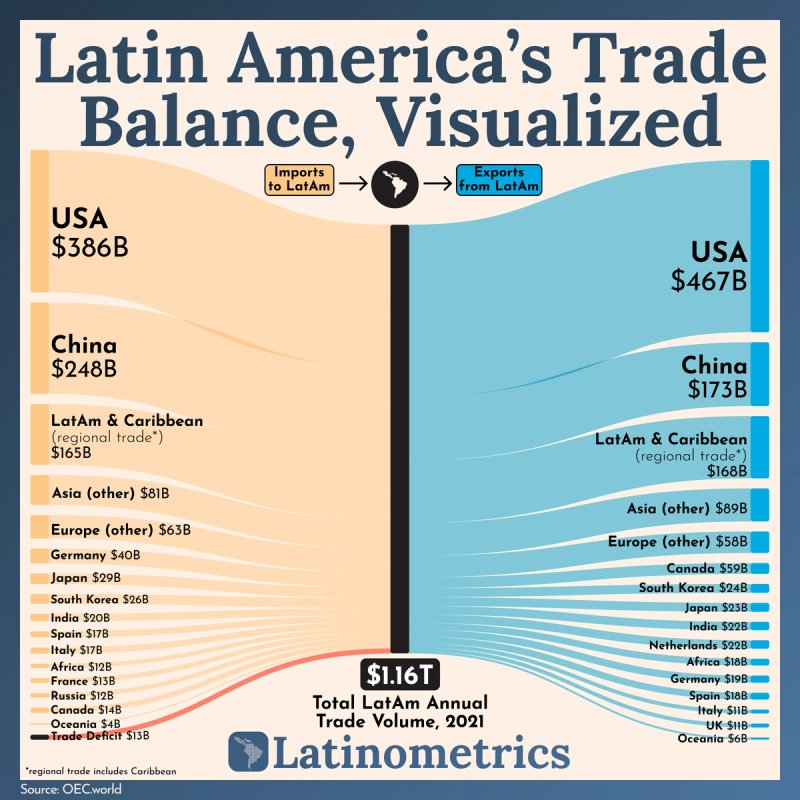
If you can best understand a region by its trade partners, then people who love Latin America understandably like to look abroad. All of the world’s largest economies — the United States, China, the European Union, Japan, India, Canada, and the United Kingdom — are represented when looking at both regional imports and exports.
In the case of the two largest of these, over $1T worth of goods and services were imported and exported in 2021 between Latin American countries and China and the United States. Specifically, Chinese trade with Brazil and US trade with Mexico form a sizable bulk of this commerce, as the former is powered by commodities and the latter strengthened through considerable North American economic integration.
There are also some other interesting trade partners to observe. Germany, which is Europe’s industrial powerhouse and a country of just 80M people, saw two-way trade with Latin America reaching nearly $60B in 2021. Powered by imports of German manufacturing, this figure represents almost double the total bilateral figure seen between Latin America and the continent of Africa, which has a population of over 1.2B people.
Within Latin America itself, regional trade topped over $165B—not bad, but a far cry from the figures seen heading to either DC or Beijing. For a region of over 650M people, deepening the commercial links between major local economies such as Argentina, Chile, and Colombia is critical towards the region’s long-term growth and development. This will lead not only to better jobs and opportunities staying in the region, but also increased cooperation and integration politically.
After all, the region saw a global trade deficit of roughly $13B in 2021, most of which was tied to China. This obviously isn’t the end of the world and countries can absolutely run commercial deficits (see: the US and most of the developed world). But as Latin America develops and comes into its own, being able to move from a region which exports raw minerals and imports finished goods towards a more sustainable and value-added exporter will lead to better jobs, better growth, and better lives for the region’s citizens.


