
Latin America's EV revolution is made in China
While the US and EU block them with tariffs, Chinese brands now own Latin America's EV market, and the factories are starting to follow.

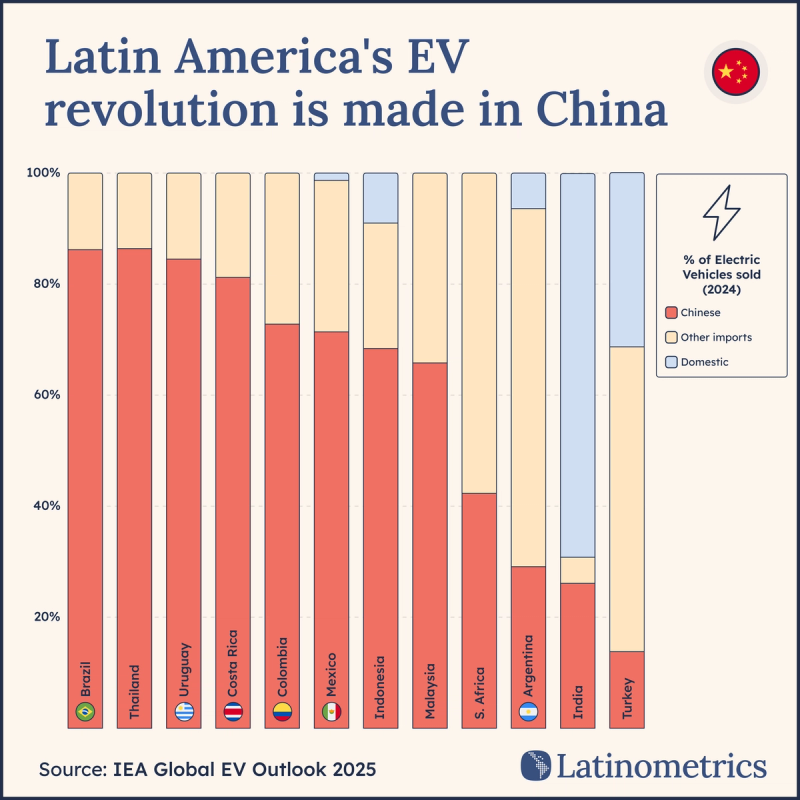
Walk through Bogotá, São Paulo, or Mexico City today and the EV badges you spot most aren't Tesla. They're BYD, Great Wall, and Chery, names many drivers north of Mexico wouldn't recognize.
And one country is making nearly all of them: China now produces more EVs than the rest of the world combined.
And as this chart using IEA data reflects, Chinese-made cars make up a comfortable majority of all EVs sold across key Latin American markets like Brazil, Colombia, and Mexico as of 2024.
China's EV Exports to Latin America
While US or European readers may be more used to seeing Tesla in their cities, for much of Latin America the logo most associated with the EV revolution is three simple letters: BYD, short for Build Your Dreams, the world's top electric carmaker since 2025.
Part of the reason for this contrast lies in government action. The US has used national-security regulations and tariffs exceeding 100% to cripple the efforts of BYD or peers like Great Wall Motors to enter the US market. While far less drastic, the European Union has also imposed tariffs on Chinese-made EVs to counter Beijing's subsidies and protect legacy automakers in Germany and France.
Meanwhile, Latin America (which has long imported most of its cars anyway) has been mostly open for business. Accordingly, in every major regional market except Argentina Chinese EVs make up at least 70% of new EVs sold. In Brazil, the largest market, Chinese EV penetration is over four-fifths of the total.
Build Your Dreams…Here
Now, just because Latin America largely lacks its own car giants does not mean that the region must miss out on the benefits of an EV production boom.
Latin American governments are taking steps to ensure that electric vehicles are also made locally, rather than just imported from China. Brazil, for example, has gradually scrapped its tariff exemptions on clean technologies, with import taxes on EVs going from 0% in 2023 to 18% in mid-2024 to 35% by July 2026.
These tariffs are designed to encourage foreign (particularly Chinese) automakers to invest in local factories. And they appear to be working: in July 2025, the first EVs rolled off the line at BYD's primary Brazilian facility, a former Ford factory in the northeastern state of Bahia.
China may well keep dominating the cars the world drives. But the factories building those cars, and the jobs that come with them, are increasingly Latin American.
| Country | Chinese share of EVs sold (2024) | Battery EVs sold (2025) | Top Chinese brand, how it sells | Tariff on Chinese-built EVs | Chinese-brand plant |
|---|---|---|---|---|---|
| Brazil | 86% | 80,178 (+30%) | BYD, own network of 180 stores | BYD Camaçari; GWM Iracemápolis | |
| Mexico | 71% | ~54,000 | 50% since Jan 2026 | None | |
| Colombia | 73% | 19,724 (+115%) | BYD, via Motorysa | 5% inside a 20,000-unit quota (2026) | None |
| Argentina | 29% | BYD, own subsidiary since Oct 2025 | 0% inside a quota for cars under $16,000; 35% outside | None | |
| Uruguay | 84% | 13,500* | BYD, via Sadar | 0% since 2017 |
Sources: IEA Global EV Outlook 2025 (origin of EVs sold, 2024); ABVE, ICCT/INEGI, Fenalco-ANDI, IEA GEVO 2026 (units; *Uruguay includes plug-in hybrids); DOF Mexico, MinCIT Colombia (Decreto 0595/2026), argentina.gob.ar (Decreto 49/2025), IMPO Uruguay (Decreto 325/017); company sites. Blank = no official or institutional source found.


