
16 million LatAm developers now build on GitHub
Exploring this century's new frontier of potential.

How much does code impact your life? You wake up to an alarm, check the weather, the news, and your messages from loved ones. You listen to a meditation, track your run, review your meetings, and order more coffee beans. Unless you're a big technology contrarian, all of this happened in the digital world (a world worth an estimated $16T, or 15% of global GDP), through various combinations of pixels on your screen, and it's barely 10 AM.
Today, 74% of the world's population is connected to the internet, and the average person online spends nearly 7 hours a day there (about as much time as they sleep).
What might surprise you is how quickly Latin America has become central to all of it. If you live in any of the region's big cities, you've probably noticed flashy office openings like Google's center for 400 engineers in São Paulo, Salesforce's 192K sq ft office across five floors in Mexico City, or IBM's shared services center out of Bogotá.
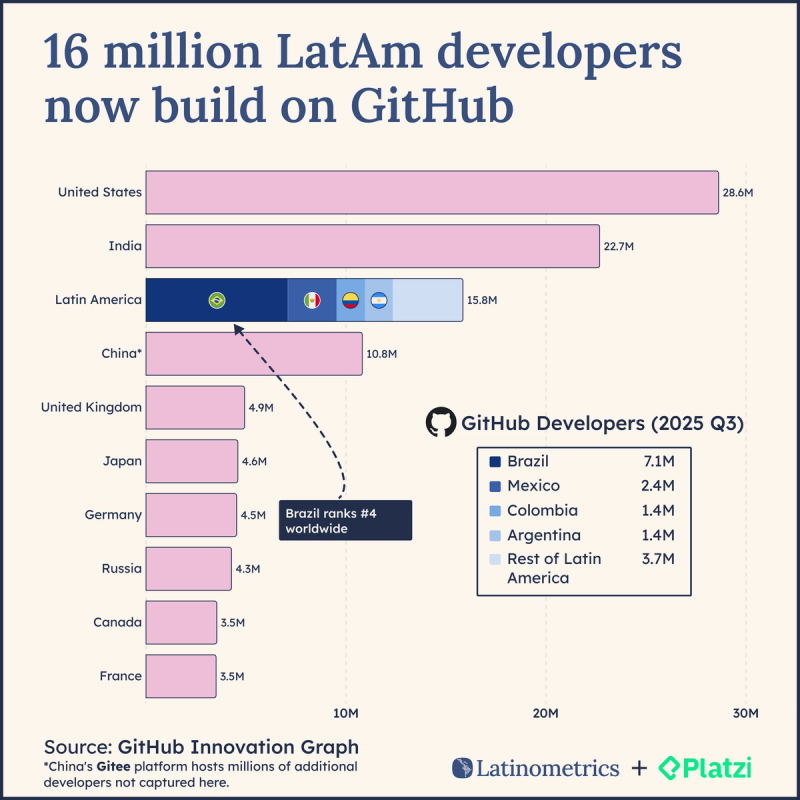
All of which rely on local talent to operate. Talent that wasn't nearly as present even 5 years ago as it is today. In late 2025, there were 16M Latin American developers on GitHub (the world's code library). When GitHub began reporting in 2020, there were 3.3M.
Source: GitHub Innovation Graph (2025)
In those 5 short years, Brazil became the world's 4th largest home of developers, while Uruguay and Costa Rica became the most concentrated hubs of per capita developer talent in Latin America, topping Japan.
As you read this, a developer in Buenos Aires is building a payment API for a fintech company while another in Guadalajara is writing firmware for a car manufacturer. And unlike a doctor or a lawyer, they don't need a license or a hospital; just a laptop and WiFi. That's it.
Behind every new startup, every nearshore hire, and every fintech unicorn, there's someone who had to learn to code first. And increasingly, learning is taking place on platforms built specifically for them.
In 2015, Platzi had 80K students. Today, the Bogotá-born edtech platform has over 5M across 140 countries, with 1,700+ courses spanning everything from AI and cybersecurity to leadership and marketing.
We partnered with Platzi on a data storytelling course in 2024 (which has 375+ reviews and a 4.7 star rating). Back then, AI was barely part of our workflow. Today, it's inescapable: AI assistants write code, catch bugs, and explain unfamiliar codebases in plain language. You probably know someone at work who had no coding background but now builds code non-stop (and won't shut up about it either).
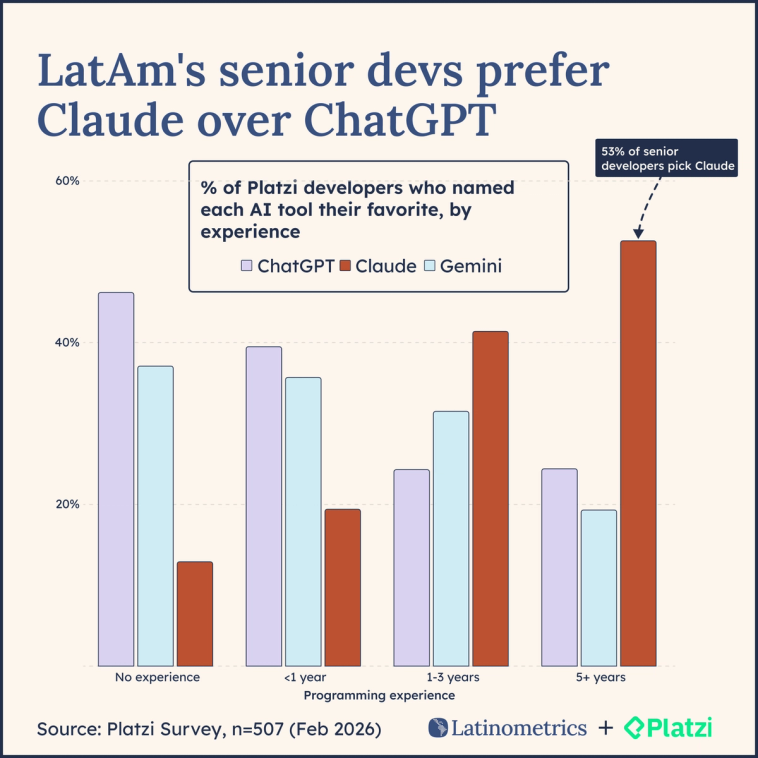
So what AI tools do these developers use? In a recent survey with Platzi, we found that 53% of developers with 5+ years of experience named Claude as their preferred AI coding tool, ahead of ChatGPT and Gemini. Beginners still lean toward ChatGPT, but the more experienced the developer, the more likely they are to pick Claude.
Our region spent the 20th century exporting commodities: Copper, oil, and soybeans paid the bills. But in this century, code doesn't require a mine or a port. It scales from a laptop in Medellín the same way it does from one in Mountain View.
Platzi is giving Latinometrics readers 10% off any subscription. We built our own data storytelling course on their platform back in 2024, and it's still going strong at 4.7 stars — same place 4,000+ LatAm companies train their teams. Use code LM10 at checkout.


