
Where US Hispanics are settling (and leaving behind)
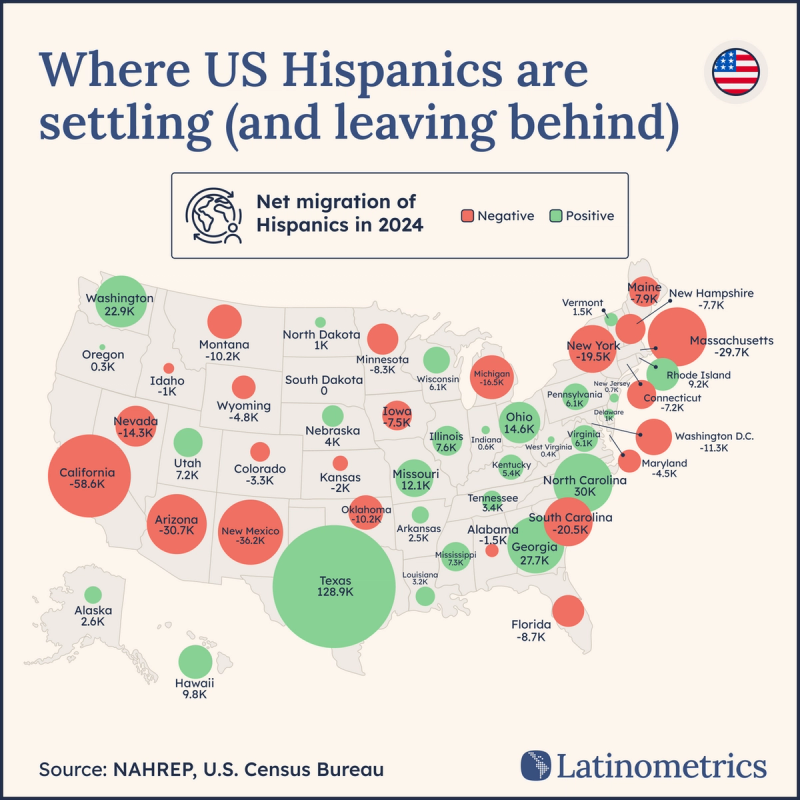
California saw 60K Latinos leave in 2024, while Texas gained 128K, driven by cost and new opportunities.


The 2020 census estimated there were over 62M Hispanic/Latino Americans in the United States, making up just around a fifth of the country’s total population. Latinos continue to be one of the fastest-growing minority groups in the country, and there are no signs of this slowing down.
Based off latest State of Hispanic Homeownership Report, we see that there continue to be large-scale shifts in terms where Hispanics are choosing to set up shop. For the third consecutive year, Texas has the largest net growth in Latino residents, with over 128K new locals. In the last fifteen years, Texas has clinched this top spot an impressive nine times.
Contrast this success with the other three border states, all of which lost thousands of Latino residents in 2024. California, historically one of the largest homes of Hispanic Americans, saw net outflows of nearly 60K people last year. Arizona and New Mexico did not fare much better.
Part of the story is likely to be tied to cost. For example, California has the highest top marginal individual income tax rate in the country, while Texas has no income tax at all. Two other states without income tax, Alaska and Washington, also saw some modest growth.
And overall, we’re seeing a trend away from the more expensive traditional coastal regions (California, New England) towards cheaper pastures. And this trend appears to be apolitical: Latino bastions like Florida, Nevada, and New York each saw Hispanic residents move out in droves in 2024. For those keeping score, that’s a deep-red state, a swing state, and a historically blue state.
Cheaper regions like the Midwest and South are attracting these residents. After Texas, two Sun Belt states – North Carolina and Georgia – have emerged as top destinations. Following the pandemic and the rise of teleworking, residents are seeing the value of homeownership in these cheaper, less competitive states.


