
🦾 Mexican Robots
Mexico installed more industrial robots last year than every country in the Americas except the United States.


This week, we partnered with Siemens. A company responsible for a big part of the trend below.
In the mid-1960s, the Mexican government introduced the Border Industrialization Program, which helped employ local workers just south of the US–Mexico border in largely duty-free and tariff-free factories called maquiladoras.
This enormously successful program helped industrialize the country. Over time, the national manufacturing sector was able to secure production and supply chains for high-value goods such as cars and computers, even as lower-cost, basic goods were produced in China or Southeast Asia.
Today, the nation stands as the pride of Latin American industry, and manufacturing is a cornerstone of the national economy. And in keeping with its proud tradition of technological advancement, Mexico's industrial sector is integrating advanced robotics into its production facilities. In fact, the country is already a global robotics heavyweight.
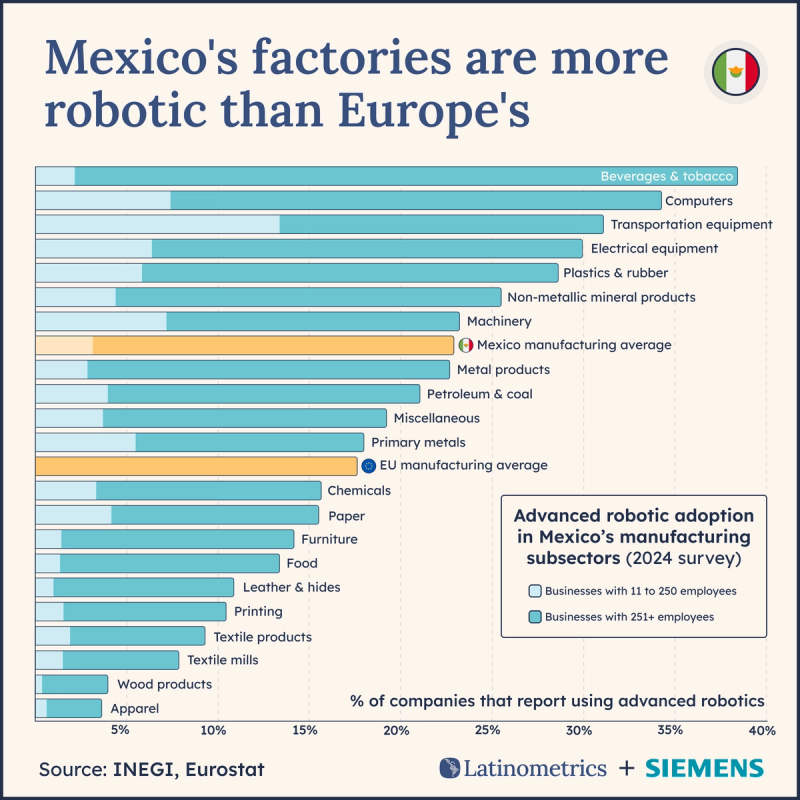
At 5.6K units installed in 2024, Mexico is the second-largest robotics market in the Americas, behind only the United States. Globally, meanwhile, Mexican manufacturing companies report an average advanced robotic adoption rate that is about 5% higher than the average seen in the European Union.
Notably, larger companies across nearly every subsector adopt robotics at materially higher rates than small and medium-sized enterprises (SMEs). Translation: if you're Ford or FEMSA, you've got robots. If you're a mid-sized auto parts supplier in Querétaro, probably not so much. The nation's leadership in automation is real, but unevenly distributed.
Source: INEGI, Censos Económicos (2024)
Transportation equipment is the subsector where local SMEs are farthest along in terms of robotic integration. This subsector, responsible for roughly 20% of national manufacturing output and over $170B in annual export value, is the crown jewel of domestic industry.
Given its enormous advancements in recent decades and ability to stay ahead of the markets, the auto industry can perhaps serve as a model for SMEs in terms of harnessing resources and know-how.
$325B in foreign investment is expected to flow into Mexico over the next decade. The multinationals and tier-one suppliers already have their robots humming. But for the thousands of smaller manufacturers that make up the backbone of the country's industrial base, the clock is ticking to modernize before the next wave of production passes them by.


