
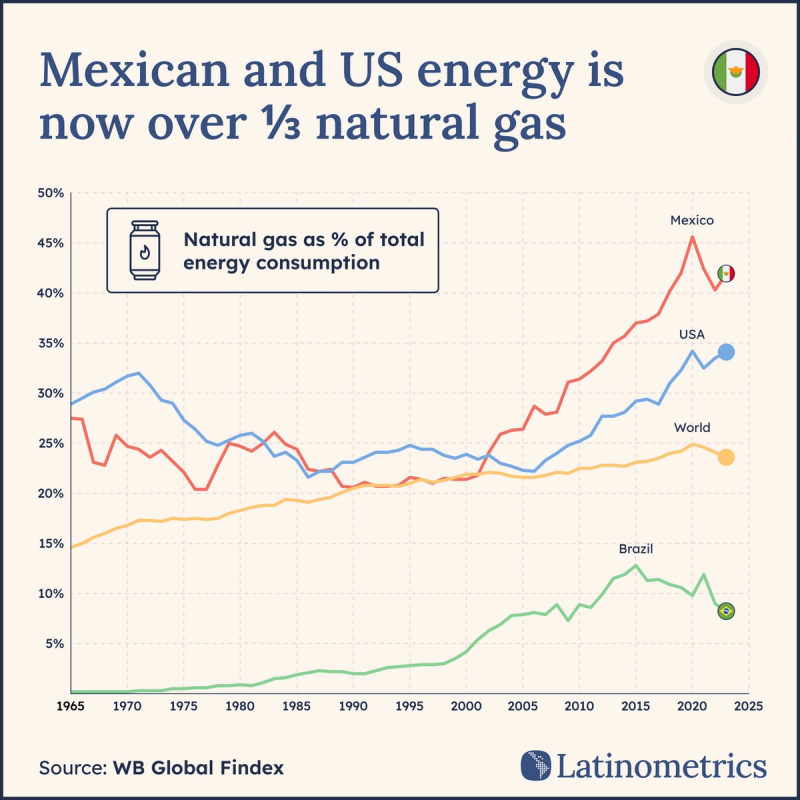
Mexican and US energy is now over ⅓ natural gas
The role of natural gas in shaping US-Mexico energy relations.

It’s not every day that an official European government social media account claps back at a US presidential candidate.
And yet, that’s what happened this week, when the German Foreign Office took to X, formerly Twitter, to mock and reject comments made by former President of the United States Donald Trump.
Now, we don’t just bring up Germany because we’re petty and love Twitter drama. There’s actually a key similarity between the world’s third-largest economy and Mexico—a similarity tied to natural gas.
Today natural gas is an increasingly central part of both the US and Mexican energy grid. Both countries have seen natural gas top a third of all domestic consumption; Mexico is in fact approaching half.
What’s behind this? Well, for that you should look to the massive shale gas deposits found across states like Texas and Pennsylvania. The US has been the world’s largest natural gas producer since it surpassed Russia in 2011, despite being only ranked fourth globally in proven reserves.
In fact, not only is natural gas the single largest source of US energy production, but the country has also been a net exporter since 2017, which is what brings us to Mexico. As you can see in this next chart, the US natural gas industry is very much relevant for Mexico’s policymakers and businesses.
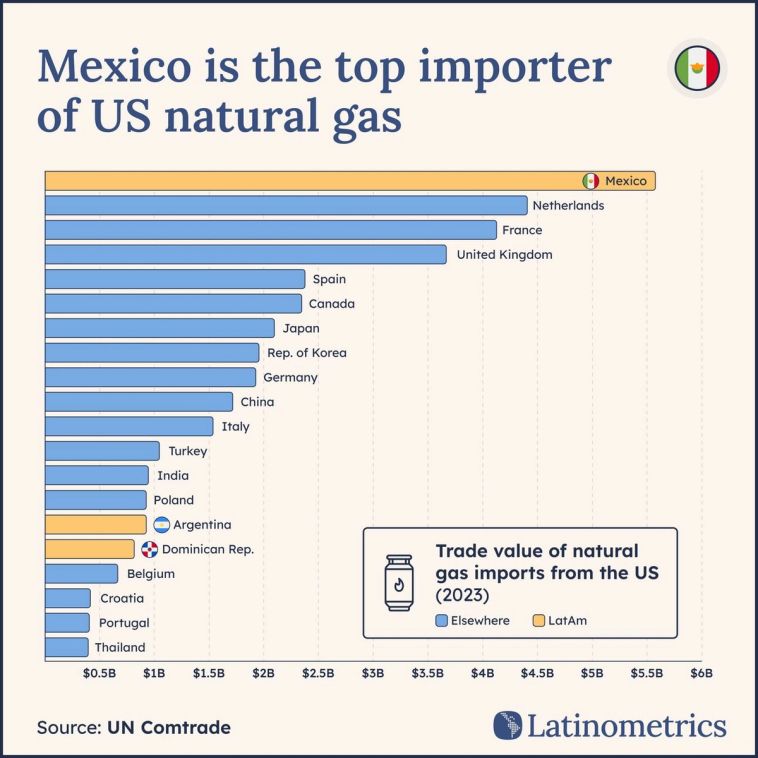
Natural gas has always been easier and cheaper to transport overland, to nearby countries, than across the seas in liquified form. Given that, transborder pipelines have cropped up in recent decades to bring US natural gas to the nearest logical market, Mexico. Unlike the US’s other neighbor, Canada, Mexico does not have substantial shale gas deposits of its own.
High energy needs as a result of its industrialization and development have made Mexico reliant on its northern neighbor’s gas exports, not unlike Germany’s historical reliance on Russian natural gas throughout the 2000s and 2010s.
Obviously we expect much less chance for a similar rupture in relations between Mexico and the US (no matter which controversial policies get floated). But in the complex web of global interdependence, where energy prices are everything, the Mexican case should be studied.


