
New Mexico Now Produces More Oil Than Mexico (& Venezuela)
New Mexico's oil boom drives Burger King wages to $28/hr, 47% higher than NYC's $19/hr.

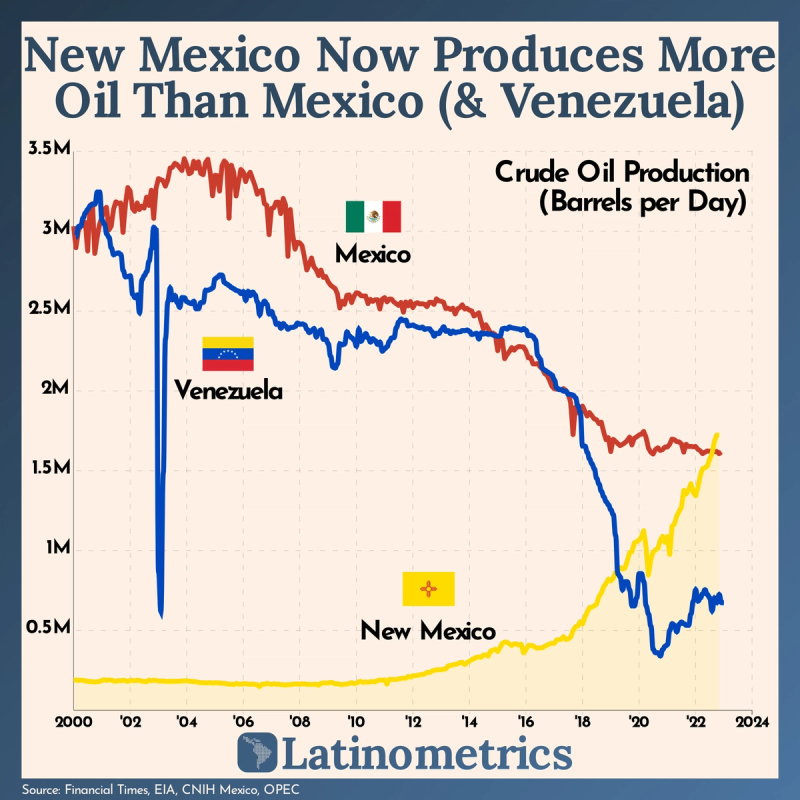
With a tiny fraction of the population of Venezuela and Mexico, the US state of New Mexico has experienced a boom in its oil & gas sector in recent years, surpassing the LatAm oil giants' production. According to a Financial Times story by Myles McCormick, the boom accelerated after Russia invaded Ukraine, which drove Russia out of the list of US suppliers, and demand for domestic oil to record levels.
Aside from the obvious economic perks this brings to the state and the US, New Mexico's workforce is thriving. There's been a great decline in unemployment and a great increase in wages. People working in the industry can earn over $27/hour, forcing companies in other sectors to compete. According to McCormick, Burger King is now offering $28/hour in NM, compared to $19/hour in New York City (so 47% higher than one of the most expensive cities to live in).
McCormick's analysis also points out that the increased production has taken the state's budget from $6B four years ago to around $9.5B this year, leading to increased spending in education, housing, healthcare, and infrastructure.
In contrast, oil-rich Mexico and Venezuela have struggled to maintain production levels. Today, they output a fraction than during their peaks.
In the case of Mexico, production has been declining since the mid-2000s, mainly due to years of mismanagement of PEMEX, Mexico's state-operated oil company. Mexico's Cantarell oil field was once one of the largest in the world. At its peak, it produced over 2M barrels daily, more than the country's current entire output. Nowadays, the number is less than 160K barrels per day.
In the case of Venezuela, the country has become a grim reminder of the risks of centering a country's economy around a single resource.
Venezuela became a petrostate over the 19th century, with oil sales making up 99% of its export earnings and one-quarter of its GDP. The lack of diversification of the country's economy made it dangerously vulnerable to fluctuations in oil prices. They fell sharply from $100/barrel in 2014 to $30/barrel in 2016, sending Venezuela's economy into a downward spiral and quickly driving foreign investment out of the country.
The lesson? Instead of blaming corruption or using the old phrase "don't put all your eggs in one basket," there's a much simpler way of looking at it: Capitalism is a far more effective force for managing and sustaining the production of natural resources for the benefit of a state and its residents.


