
Mapping organized crime in the Americas
Latin America has a big problem with transnational criminal networks.


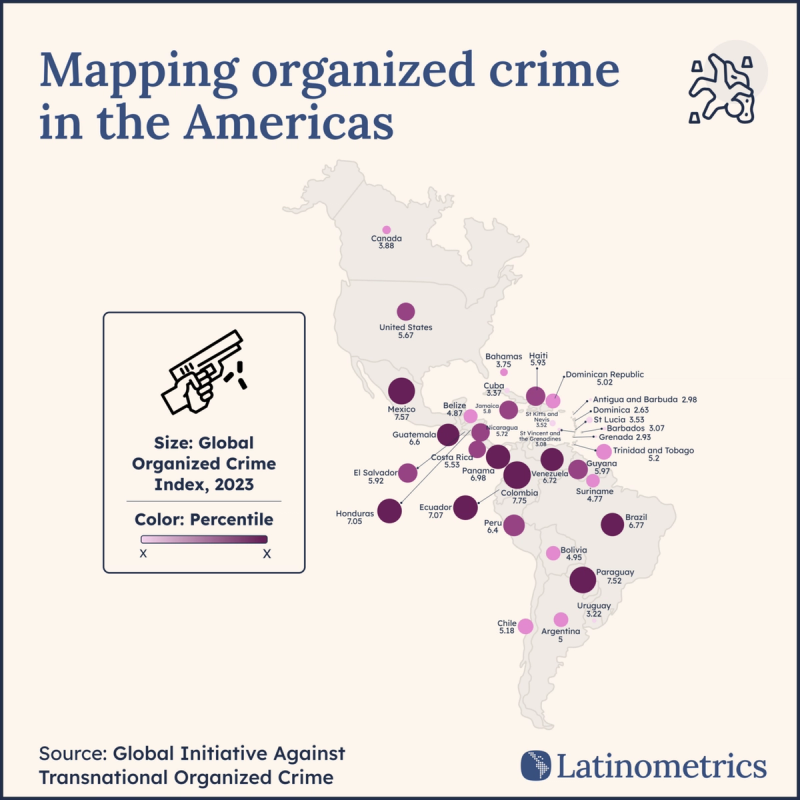
Despite substantial progress over the last few decades, it’s undeniable that Latin America today continues to have a crime problem.
What the region lacks in interstate conflicts and wars can rather be found in organized crime, and illegal networks which span different sectors and nations. In fact, one recent report from the Inter-American Development Bank noted that a whopping 40% of Latin American citizens ranked crime as the dominant issue facing their countries.
Now, Latin America’s three most populous countries – Brazil, Mexico, and Colombia – are all ranked among those with the highest degree of criminal presence. This can be explained in part due to the transnational criminal networks which span all three countries, ranging from the PCC to the Sinaloa Cartel.
In recent years, these organizations have expanded their reach and zones of operations into smaller countries. The PCC is now particularly active in Paraguay, which has limited capacity for resilience, while the Sinaloa Cartel (and its rivals) have contributed to Ecuador’s massive spike in narco-violence.
Uruguay, as usual, provides a key bright spot, while other countries with relatively better reputations – think Costa Rica or Panama are held back in part by their struggles to crack down on global money laundering.
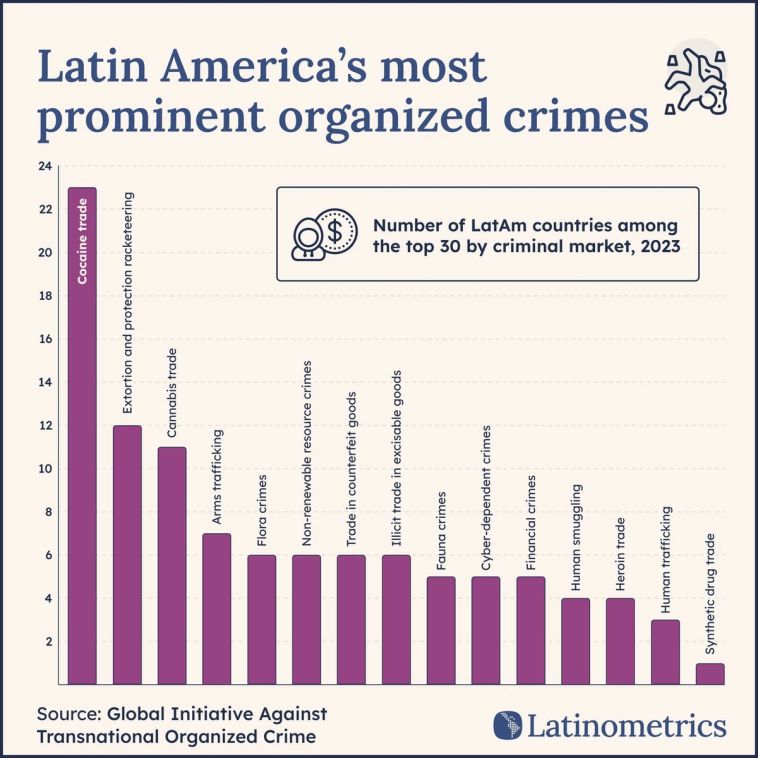
Of course, the region is most beset by issues linked to the drug trade. Practically every Latin American country has to fight criminal networks smuggling drugs, particularly cocaine, to foreign markets like the US and Europe. The cannabis trade is also prominent, despite marijuana’s legalization in Mexico and decriminalization cross Brazil, Colombia, and Peru.
Lastly, we want to briefly discuss extortion and protection racketeering, a highly profitable market for which over half of Latin American countries fall within the top 30 worldwide. This industry, in which organized crime groups demand money from civilians or businesses to avoid harassment, is particularly prominent across low-income and rural communities.


