
Visualizing Latin America's $218B Annual Exports to China
China's $218B appetite for LatAm's raw goods fuels a boom, with Brazil sending half the exports.

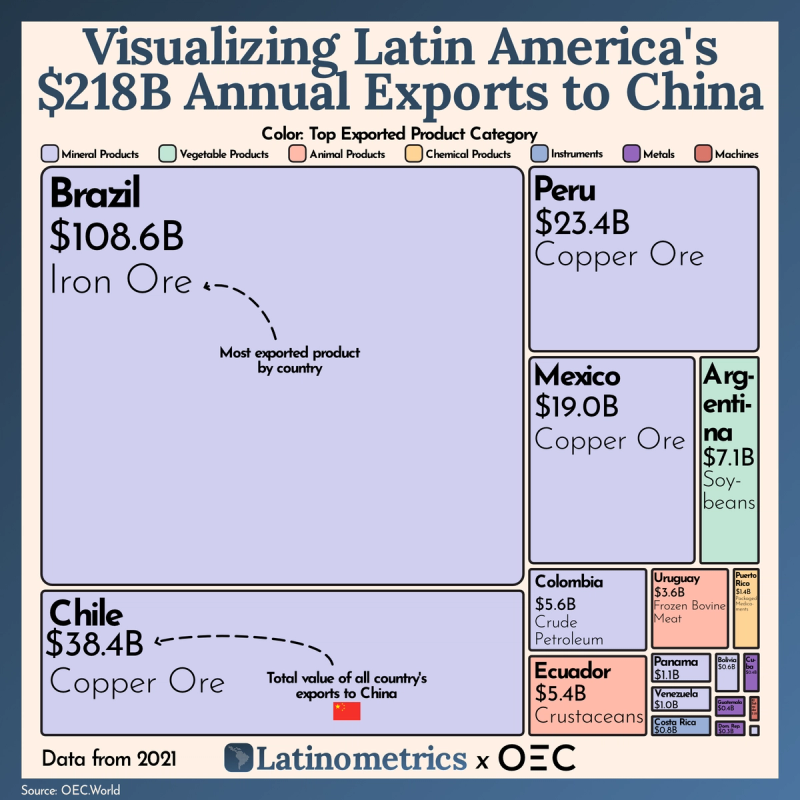
In most of Latin America, you won’t find the biggest destination for exports up north in the United States; for that, you’d need to check across the Pacific. Regional exports to China topped $218B in 2021, according to data from our friends at oec.world, and show no signs of slowing down.
China has been a major customer since the turn of the century. Its demand for raw goods powered Latin America’s greatest era of economic growth in modern history, the so-called commodities boom. Today, China is either the largest or 2nd-largest trade partner of all the region’s major countries.
Brazil, naturally, leads the pack with half of all regional exports to China, its largest trade partner since 2009. Over a third of the country’s exports headed to China in 2020, which explains why Brazil is one of the rare countries to run a positive trade balance with the world’s 2nd-largest economy.
The tight commercial relationship between the two BRICS partners is powered by Chinese demand for many Brazilian commodities—especially iron ore (its top export in 2021) and soybeans, of which Brazil is the world’s largest producer.
While neighboring Argentina is also a major player in the soybean business, Chile and Peru have found a different lucrative industry: copper ore. The two Andean countries, alongside Mexico, export significant amounts to China, the world’s largest importer of the mineral. Meanwhile, Colombia has moved in to fill the drop in supply from the region’s historical oil powerhouse, Venezuela, with crude petroleum now making up over 75% of all Colombian exports to China.
As a region rich in natural resources, Latin America is well-suited to meet the current tough moment for the global economy. After all, China will continue buying Argentine soy, Chilean copper, and Colombian oil as long as it can; it’s even invested in making resource extraction easier.
If there’s one just thing we personally hope to see, it’s a rise in manufactured and finished goods and services within Latin America’s exports in the coming years. This would reflect a big step forward in the region's development—and its long-term prosperity.


