
Regional Trade: Which Countries Trade the Most Within LatAm?
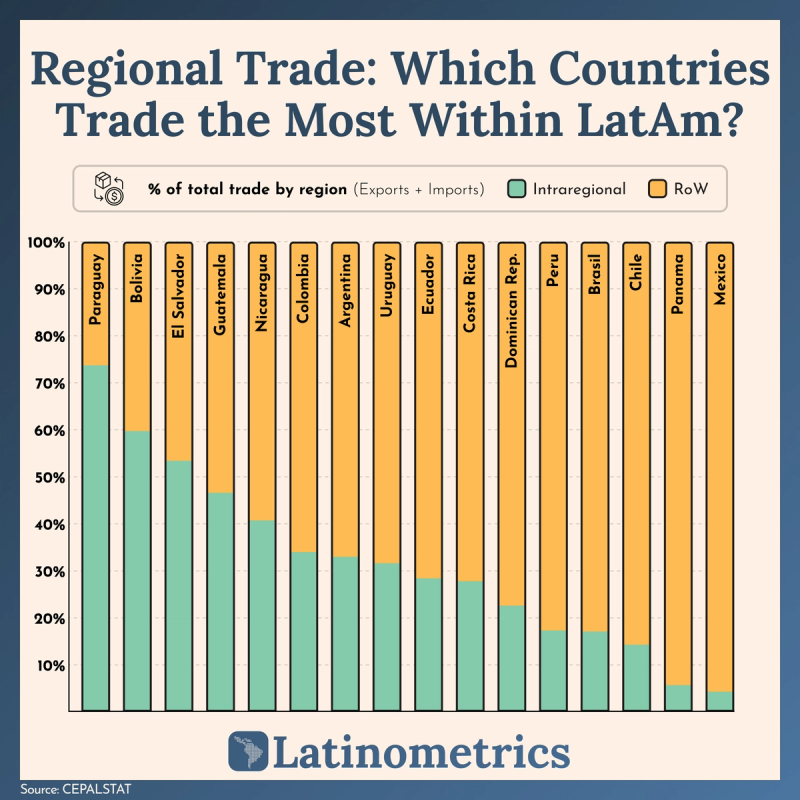
Only 5% of Mexico's trade stays in LatAm, while landlocked Paraguay and Bolivia lead regional exchange.


What are the countries that trade the most within Latin America?
Here at Latinometrics, we’ve often been quick to give Mexico its flowers.
This shouldn’t be too surprising—both of our cofounders are from sunny Torreón, after all. But it’s hard not to see the vast opportunities coming out of Mexico, a G20 economy that has low unemployment and major trade deals with some of the world’s biggest markets.
Trade is hugely important for Mexico’s economy, making up over three-quarters of the country’s GDP in 2019. But let’s be clear: most of that trade is heading north, not south.
Only about 5% of Mexico’s total trade is with other Latin American countries. The remainder heads to the rest of the world, particularly the US, showing to what degree Mexico really is an outlier compared to its regional peers.
Don’t believe us? Even Panama, notable for its liberal commercial policies, special economic zones, and international canal, trades more with its Latin American neighbors…though geography might help with that.
On the flip side, there are landlocked countries like Paraguay and Bolivia.
Both of these states import from—and export to—their neighbors more than the rest of the world. So, while the President of Mexico may need to watch US financial markets like a hawk, leaders in Asunción and La Paz would do well to ensure harmonious commercial relations with their peers in regional trading blocs like Mercosur.
Now, no doubt the future for each country in the region is a healthy balance of intraregional trade within Latin America and extra-regional trade with overseas countries. Even developed, industrialized economies like Germany will maintain robust trade ties with European neighbors like France as well åas foreign superpowers such as China or the US.
But it’s clear that intraregional trade in Latin America has failed to keep up with the region’s overall trade portfolio. Latin Americans are buying and selling more on the world market, which is good, but they are also growing increasingly dependent on external powers in the process.
And we’re hardly the only ones seeing this trend. In 2022, economic policy expert Shannon K. O’Neil of the Council on Foreign Relations assessed the effects of globalization on Latin America. According to her, the region had yet to truly take advantage of its vast potential, particularly owing to weak intraregional commercial ties.
So perhaps Mexico’s future doesn’t have to just be with the US, or Brazil’s merely with China. Perhaps the future are these countries’ very own neighbors.


