
Revenue Breakdown: Telefónica
Telefónica's Latin American divisions now out-earn Spain and Germany, fueled by Brazil's 17.5% growth.

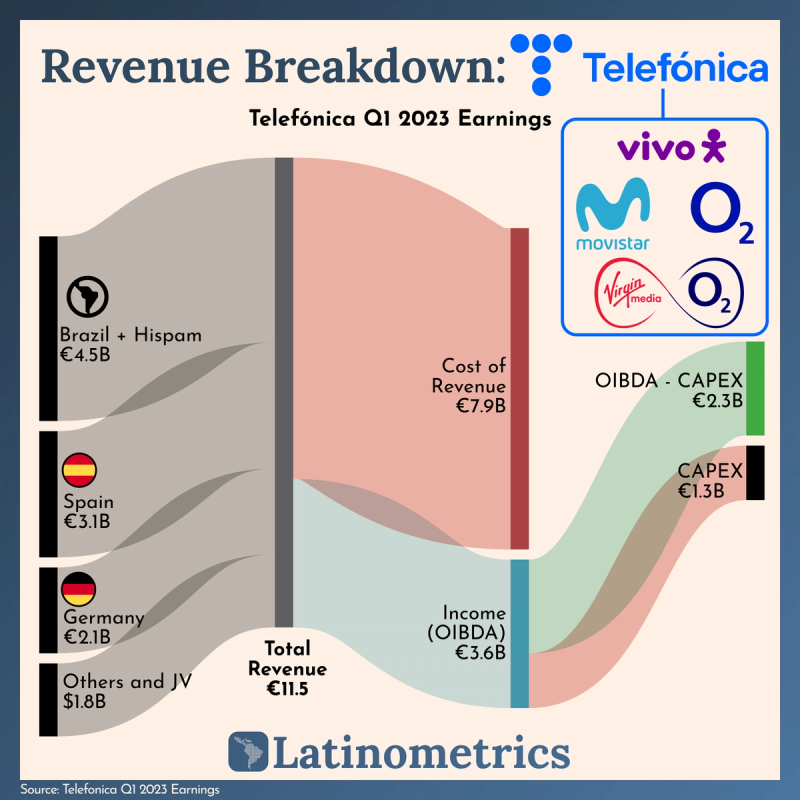
If you're reading this from somewhere bordering the Atlantic right now, you're probably using mobile data provided by some subsidiary of Telefónica, Spain's 2nd-largest company and the world's 8th-largest mobile network operator by number of subscriptions. The Madrid-headquartered firm has been a major player across Latin American telecommunications for decades.
How major a player? Telefónica runs the largest privately-owned fixed-line operator in Argentina, Brazil, Chile, Colombia, Peru, Uruguay, and Venezuela, while being a distant second in Mexico. Not too shabby for a company hitting its 100th birthday next April.
Telefónica may have seen its general revenues fall in Q1 of this year compared to the previous quarter. But the Hispam division, which covers Spanish-speaking Latin America, grew by an impressive 6.3%, making it the best-performing division in the company. The company fared particularly well in the major markets of Colombia and Chile.
Meanwhile, the multinational’s Brazilian subsidiary, Vivo, has performed the best in annual growth, seeing a revenue increase of 17.5% over the previous year. Vivo was helped by the burgeoning launch of 5G across Brazil, with high demand for new terminals strengthening business. By the end of March, Telefónica’s service covered 58 cities nationwide.
Taken together, Telefónica's Latin American holdings brought in an estimated 4.5B euro in the quarter, representing just shy of 40% of total revenues. This number exceeds the revenues in Spain (the company's home country) and Germany (its largest European market). And while its total global revenues of roughly 11.5B euro were smaller than anticipated, keep in mind that inflation is causing some labor and IT equipment costs to outpace price increases in this year's economy.
In any case, it's clear that Telefónica is not going anywhere and that the firm's subsidiaries west of the Atlantic—particularly Brazil's Vivo—will only continue to grow in value for the firm.


