
🪢 Services Trade
Which Latin American nations beat the US, France, and Germany in services?


So much of the modern conversation around trade remains so tragically simplistic.
Tariffs are tossed around without recognizing the intricate, transnational supply chains they're a part of. Deficits and surpluses are reduced to talking points. And too often, politicians and commentators alike spend all their time discussing the exchange of goods across borders—while forgetting the critical role played by services.
Think of giant tech firms like Meta or Google, which don't quite import and export products the way a car manufacturer would, but which still employ millions of people (and power global markets in the process).
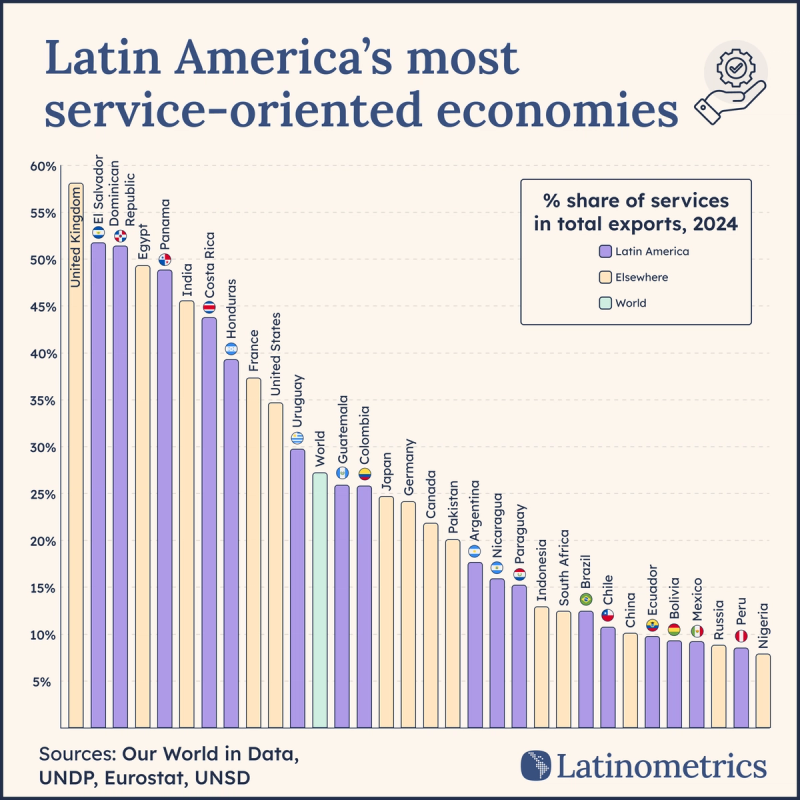
Services are an increasingly important part of the global economy, making up nearly 30% of international trade in 2024, and Latin America has also been evolving away from the farm and oil fields, to some extent.
For the region's resource-rich heavyweights, the 'commodity curse' has proven a hard habit to break. Bolivia, Brazil, Ecuador, and Perudon’t rely too extensively on service exports, given their economic model continues to rely heavily on the export of raw minerals, agricultural goods, and hydrocarbons.
Meanwhile, Latin America’s sole manufacturing success story, Mexico, is interesting for other reasons. Mexico’s services make upover half of its modern economy, and employ over 60% of its workforce.From a $30B tourism industry to the largest retailers in Latin America (hello Walmart and Oxxo), the Mexican tertiary sector has become a strong driver of its internal consumption.
Yet similarly to China, the world’s second-largest economy, Mexico’s service exports remain a small part of its trade profile. As the true factory floor of North America, Mexico’s overall exports still consist overwhelmingly of goods—reflecting an industrial development that hasn’t translated to major digital multinationals like in Europe or the US.
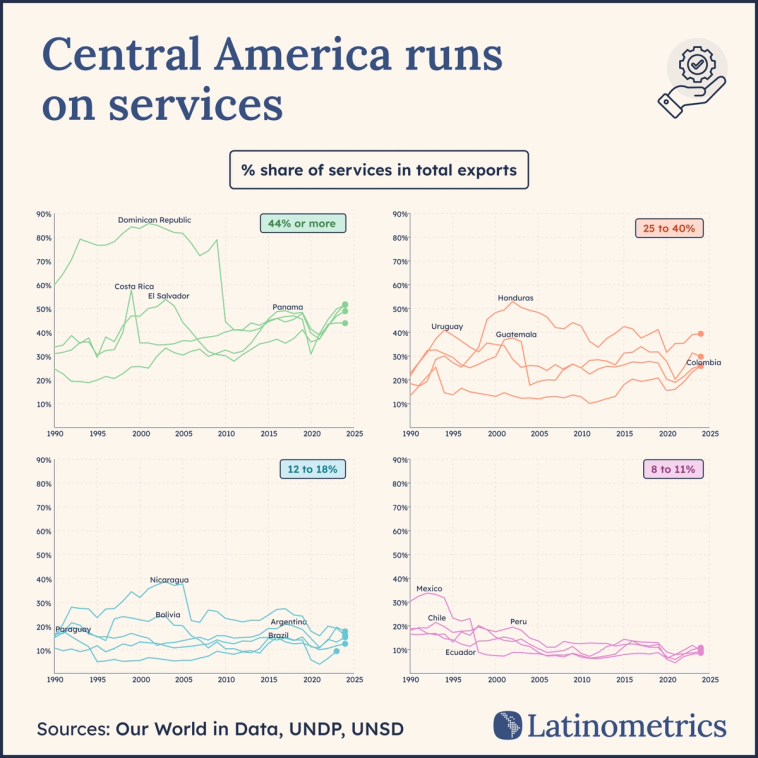
If Mexico’s exports look like China’s, then just south more closely resembles India (wait, let us land this).
Much like India, the small Central American and Caribbean nations of Costa Rica, El Salvador, Panama, and the Dominican Republic have all made names for themselves as major service exporters.
Services make up at least 40% of total exports in these countries, driven by a mix of massive tourism sectors and a surge in business process outsourcing (BPO), IT support, and financial logistics.
Proximity to the United States (and the righttimezones) all play a role, as do lower wages and an English-speaking workforce with strong links to the US consumer market.
Just how strong of links? Well, one 2017 investigation found that call centers were even being staffed by locals who had been deported from the US.


