
Latin America’s top builders of smart buildings
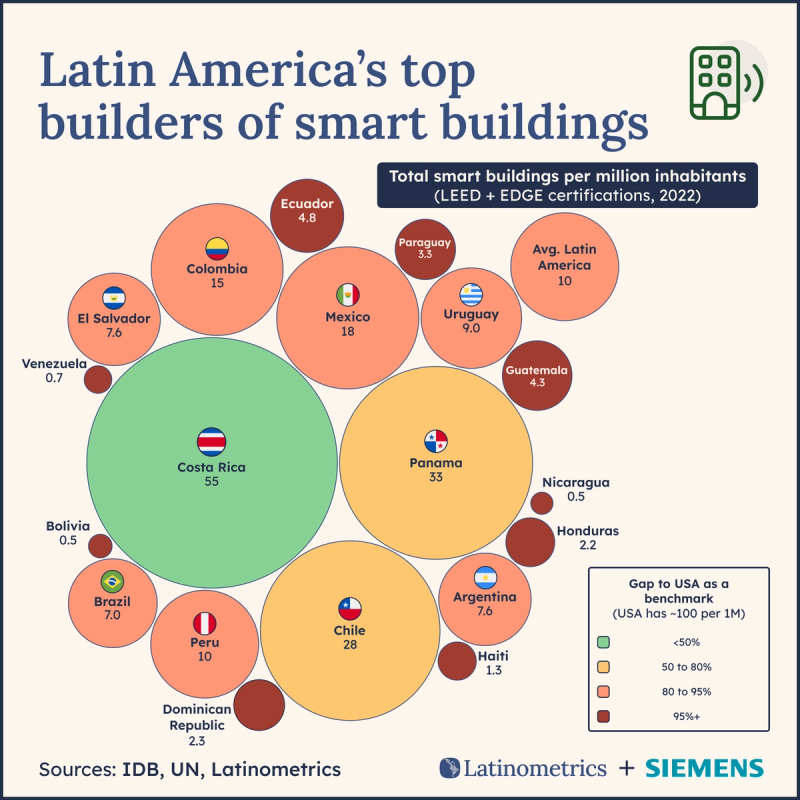
Latin America deploys only one-tenth the smart buildings per capita as the United States, but some countries are changing that fast.

The nature of modernization is that everyday people don’t always see the strides made by businesses and societies. After all, not everyone gets to tour the factory floor or see the robots which today roam the halls of trade shows worldwide.
But technology comes into our lives in new, exciting ways. Take smart buildings, which are infused with wireless centralized automation—like hotels that turn the AC on only when a guest checks in, or a round-the-clock security system that can alert homeowners even when they’re out.
And while the term “smart building” may sound new, the region has flirted with the concept for far longer than many realize. As early as the 1980s, Mexico introduced one of Latin America’s first modern intelligent buildings. The Torre Ejecutiva Pemex has been recognized as the first smart building in Mexico thanks to its pioneering building management system (BMS), automated HVAC, integrated fire protection, and seismic‑responsive elevators that could stop at the nearest floor during an earthquake.
It was an early glimpse of what a fully automated future could look like—long before IoT became a buzzword.
That said, Latin America at large has yet to catch up with peers like China or the United States in terms of these smart building installations. In fact, on average the region has only deployed a tenth of the number seen (per capita) in the US.
The implications are significant: buildings are an essential part of any credible decarbonization pathway, as they account for 30% of final energy consumption and a quarter of energy-related CO₂ emissions worldwide.
However, some countries are closing the gap faster than you might think.
Costa Rica stands out as a clear regional leader with 55 smart buildings per million inhabitants, followed by Panama and Chile at a distance. This gap suggests that success is driven less by market size and more by sustained policy focus and institutional alignment.
Smaller economies such as these outperform their larger peers such as Brazil or Mexico by pairing clear building standards with access to green finance and international certification frameworks.
They can serve as models for the entire region as it struggles to accelerate energy-efficiency gains. Notably, Latin America still falls below the UN’s Sustainable Development Goal (7.3) of 2.6% annual improvement, in no small part because building systems remain largely analog, under-optimized, and just flat outdated.
But there’s hope: Latin America’s energy intensity progress rate tripled in 2025 relative to its 2010–2019 annual rate, indicating the region is making headway. A pipeline of digitally enabled buildings can help avoid a plateau of efficiency improvements throughout the ongoing expansion of clean power generation.
And Latin America is far from alone in this challenge. One estimate places the total green building investment opportunity for emerging-market cities at nearly $25T in the coming years. Technology availability is no longer the primary constraint—today it’s about harnessing financing and translating policy ambition into smart, connected buildings at scale.
Got any questions? Just ask your nearest Tico.
Our partner for this story, Siemens, delivers technologies that make buildings smarter, more resilient, and more sustainable—paving the way toward fully autonomous operations.


