
Has Economic Growth in LatAm Resulted in Higher Incomes?
Dominican Republic's GDP tripled, but workers saw just 0.7% income growth.


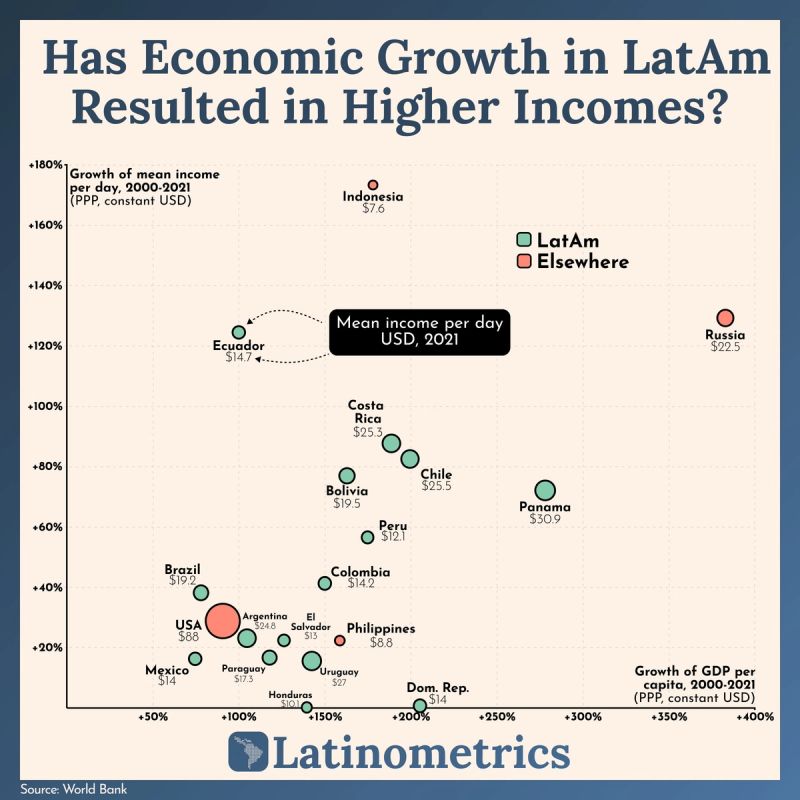
In the simplest terms, the chart above represents a country's economic growth on the x-axis and the growth of the average person's income on the y-axis. When considering both measures together, we can get a sense of how much economic growth has "trickled down" to the average resident of each country.
For example, Ecuador is an outlier in that it's the only Latin American country that has seen a growth in average income from 2000 to 2021 that outpaced that of its GDP per capita.
On the other, much less favorable extreme is the Dominican Republic. The country has grown its GDP per capita by over 200% since the 21st century began (in other words, today, it's more than triple what it was in 2000). This explosive growth has only translated to 0.7% growth in the average worker's income.
However, one final metric is essential to get the complete picture: each country's latest mean income in dollars per day, illustrated by the bubble sizes on the chart. Going back to the Ecuador example, yes, it has seen incredible growth in the last 20+ years, but nowadays, the average daily income is only slightly above the Dominican Republic's ($14.7 vs $14). In other words, Ecuador had a lot of catching up to do.
Panama deserves a shoutout. The country has the highest average daily income in LatAm. It also outpaces every other country in the region in economic growth (x-axis) and is 4th in income growth (y-axis). That looks like the healthiest balance in Latin America if we consider all three metrics.
There are likely many different views on what the right balance should be. But one thing is certain: the economic development seen on the x-axis is going somewhere. Someone benefits from it; the question, which varies wildly by country, is who?


