
Chile's economy powers a thriving stock market
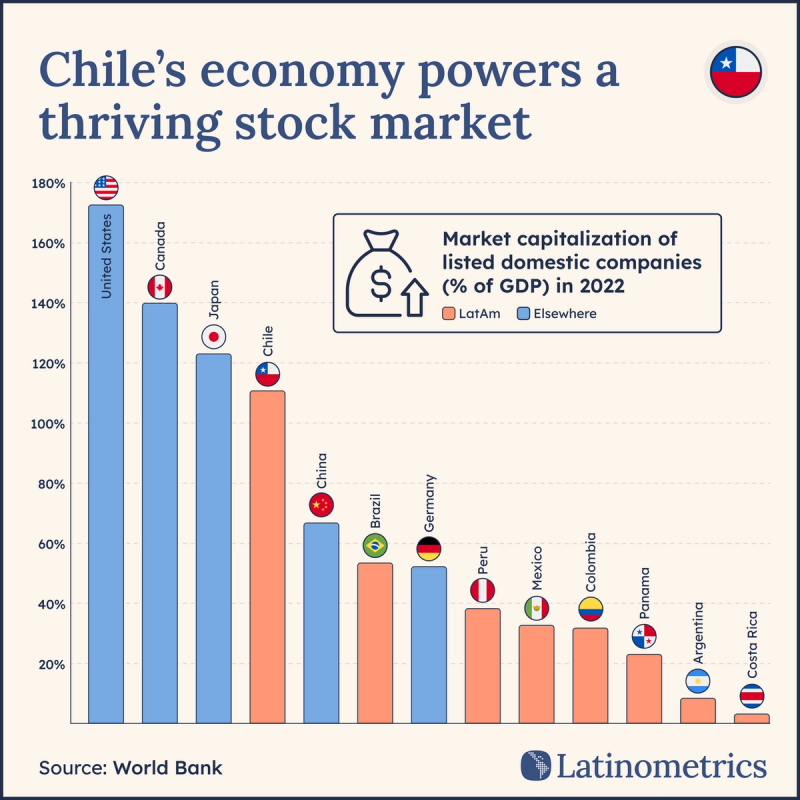
Chile's Santiago Stock Exchange ranks 3rd in LatAm market cap despite its small size.

Assessing the public markets' importance.
A wise man once said “Work brings you to the middle class, but investments let you leave it for the upper class.”
With this in mind, today let’s look at the most traditional way people invest today: the stock market.
Now, while the two most famous market exchanges worldwide – NYSE and NASDAQ – are obviously based in New York, don’t think for a second that Latin America’s stock markets aren’t also worth observing.
Ever since the Salvador stock exchange opened up in northeastern Brazil in 1817, the region has had a number of key hubs where investors could trade shares of publicly-held companies.
While you probably have heard of the B3 in São Paulo or Mexico City’s famous BMV, what you might not know is that Chile’s stock exchanges are really carrying their weight.
The country is clearly quite the dynamic market for trading in equities, particularly the 1893-founded Santiago Stock Exchange (SSE), which is impressively third in market capitalization within Latin America. Not bad for a country a tenth the size of Brazil.
Notably, the SSE has joined with the main stock markets of Colombia, Mexico, and Peru to form Latin America’s largest overall bourse, the Mercado Integrado Latinoamericano (MILA). This year, the nuam exchange is set to debut and integrate similarly with Chile, led by the former president of the Colombia Stock Exchange.
We just passed ten years since the BMV executed its first trade through the MILA system—and we wouldn’t be surprised to see greater intra-market regionalism in the future.


