
💰 Tax Rates
Paraguay boasts LatAm's lowest tax burden, with a 10% corporate rate—half its nearest peer.

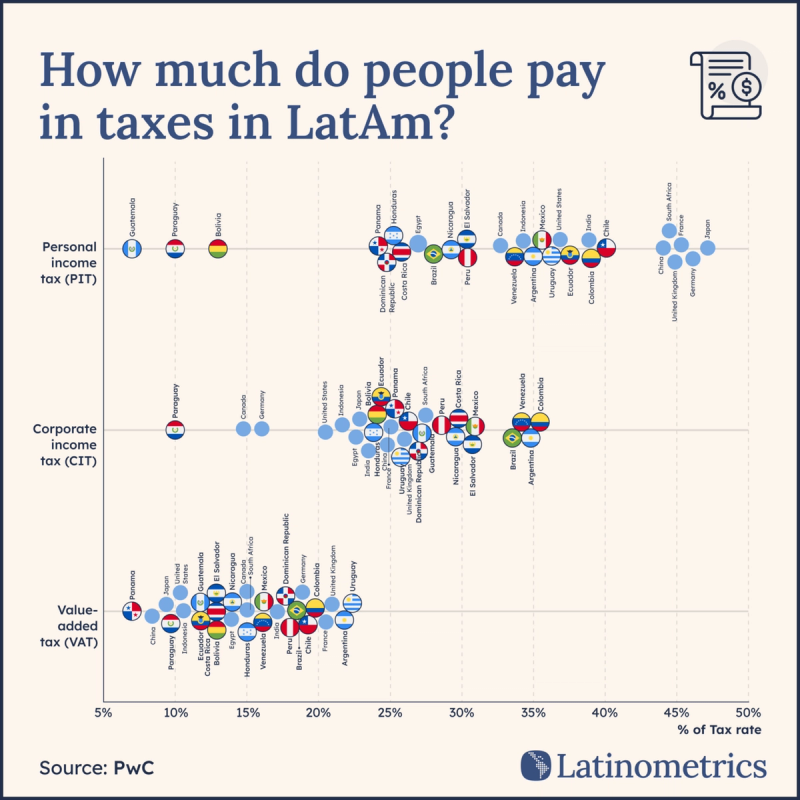
In some Latin American countries, tax season hurts a whole lot less.
When the pandemic shut down offices across the world, some workers didn’t go home. They grabbed their laptops and other meager belongings, booked one-way flights out of the country, and holed up somewhere else. Usually, that somewhere else was cheaper and had better weather.
Some of these people eventually went home, while others committed to the digital nomad lifestyle. Finally, others decided to settle in other countries as either expatriates or immigrants, an occasionally contentious distinction.
You might expect some of the usual places people settled: Medellin, Mexico City, Rio de Janeiro. Others might surprise you, like a certain capital city in the heart of South America.
But in order to understand why people move to some places over others, let’s look at tax rates in Latin America and see which country lets you keep the most of your paycheck in your pocket when the taxman comes a-knockin’.
It should be no surprise that Paraguay is seeing spiking interest in its permanent residency requirements, given it’s got the lowest tax burden in the region. The country has the second-lowest personal income tax (PIT) and value-added tax (VAT) rates in all of Latin America, behind just Guatemala and Panama respectively.
On top of that, the country has by far the lowest corporate income tax (CIT) rate in the entirety of the Western Hemisphere (minus some of those pesky Caribbean tax havens). At just 10%, Paraguay’s nominal CIT is less than half of its nearest Latin America peer.
Such a low tax burden is great for foreign investors or digital nomads hoping to set up shop, but it also means Paraguay is strapped for resources in seeking to fight national problems like poverty or hunger. This is a point in common with peers like Bolivia and Guatemala, which are also seeking to stimulate their economies and help citizens grow wealth while also struggling with severe inequality.
On the other end of the spectrum, some of Latin America’s largest economies – Argentina, Brazil, Chile, and Colombia – see substantially higher tax burdens at the personal, corporate, and value-added levels. Even with these higher effective tax rates, some of these bigger countries have also struggled with their own fiscal deficits in recent years as growing spending has outpaced tax collection.
There’s no magic formula for ensuring equitable growth, though a counter-cyclical fiscal policy been floated as one. At the end of the day, citizens, immigrants, businesses, and governments all have to weigh the pros and cons of higher or lower tax burdens when evaluating their countries’ relative advantages.


