
Trade Ties Between LatAm and the EU are Stronger Than Ever
EU–LatAm trade tops $300B, with new deals securing supply chains for green tech.

Yesterday, the 3rd European Union–Community of Latin American and Caribbean States (EU–CELAC) summit wrapped up in Brussels—and Latinometrics was there to see it all!
There were plenty of major announcements ranging from investments to development cooperation, but trade was certainly the elephant in the room. The 27-country European Union is Latin America’s 3rd-largest trade partner today, behind only the United States and China, and the bloc certainly wants to expand its opportunities with the 33 countries of Latin America and the Caribbean.
Accordingly, the European Commission signed memoranda of understanding with a number of Latin American countries, including Argentina, Chile, Ecuador, El Salvador, Honduras, and Uruguay. Chilean President Gabriel Boric also signed a modernized association agreement with the Europeans, designed to further liberalize trade—something to likely expect from Mexico within the next year or so.
At the closing press conference, President of the European Commission Ursula von der Leyen reiterated her expectation that the EU–Mercosur free trade agreement would also be finalized within the next two months. This agreement between the Europeans and Argentina, Brazil, Paraguay, and Uruguay is an ambitious EU priority over two decades in the making.
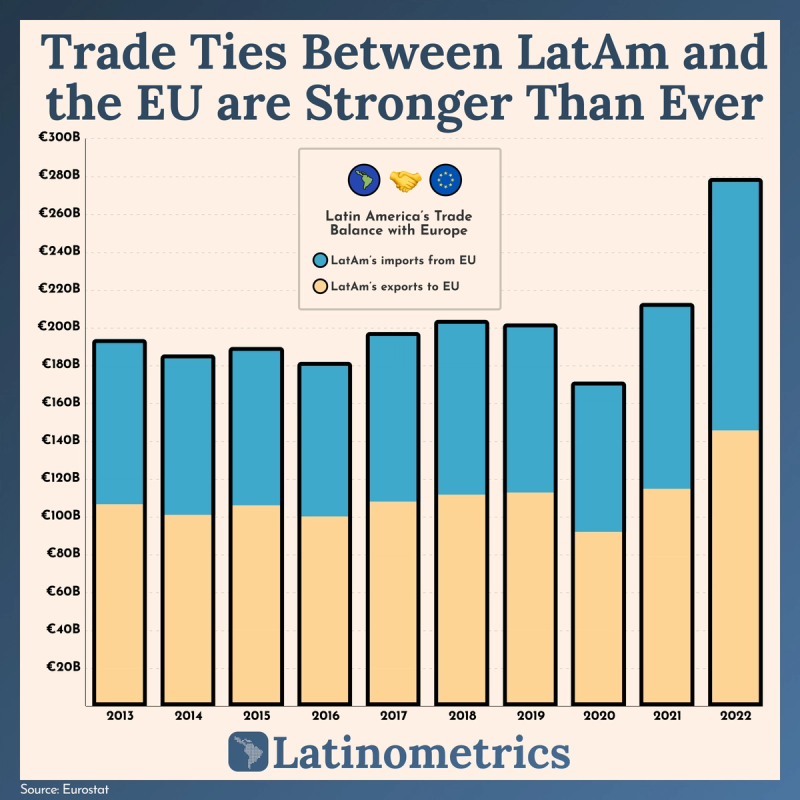
As our chart above reflects, the European Union is an important commercial partner for Latin America, particularly since the pandemic. Two-way trade topped $300B last year, with plenty of room for growth: the new agreements signed in Brussels this week are designed to secure supply chains and allow for greater trade in green hydrogen, renewable energy, and critical raw materials such as lithium and copper.
Even more importantly: the EU claims to want to avoid acting as merely extractive powers in the region, buying up all the commodities of Latin American countries, but also help in developing local, sustainable producers. These higher value-added industries will lead to better-paying jobs for Latin American workers, and move away from the current model where, say, Brazil exports beef to France and gets German cars back.
Which is to say, expect deeper transatlantic trade links going forward, particularly if the EU–CELAC summit returns to a biannual schedule. Next summit is in Bogotá in 2025, let’s check in then!


