
Total Beer Production: How LatAm Countries Compare
Mexico exports 28% of its beer, creating a $5.5B market that dwarfs Germany, Netherlands, and Belgium combined.


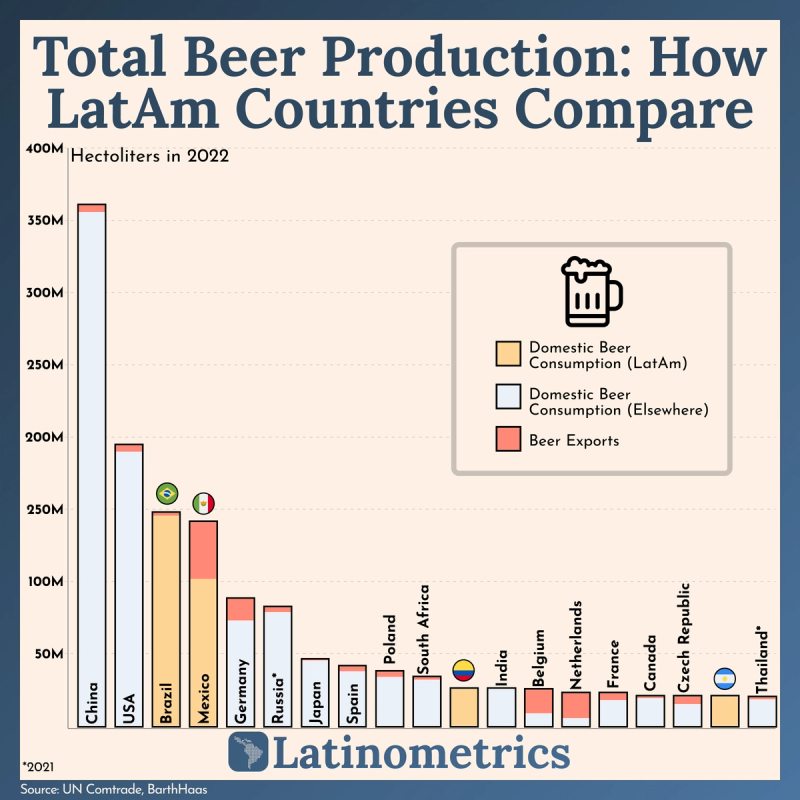
Comparing Mexico to Brazil's beer production — especially how much leaves each country — tells a story of trade potential. At face value, both countries produce about as much beer per year. For Mexico, though, 28% of all production is consumed outside its borders, representing $5.5B in yearly trade value and the biggest in the world. Brazil, on the other hand, only exports merely 1.3% of its production, which equals $120M.
Brazil's percentage resembles China's, which amounts to an incredible 350M+ hectoliters or 35B liters annually. China is the world leader in beer production, but it exports just about the same value as France. We're intrigued that multinational beer producers (mainly from Europe) turned to Mexico to create the biggest beer export market. That market is now worth more than the three old big producers, Germany, the Netherlands, and Belgium, combined.
Mexico's history of beer production dates back to the 16th century when European settlers first established breweries in the country. Europe has the world's top beer drinkers, but labor and production costs are high. In Mexico, where labor is much cheaper, beer consumption per person is about the same as in Finland or the US — 70L per year. This provides a strong foundation for the industry and allows Mexican breweries to produce a large volume of beer that can be sold domestically and exported.
There are other advantageous production conditions: with an abundant water supply, Mexico has a favorable climate for growing barley, the primary ingredient in beer. Additionally, the country's ports are well-developed and well-connected, making it easy for transportation to other parts of the world.
Lastly but importantly, Mexico's immediacy to the biggest market in the world (the US), where 85% of its beer exports go, means an enormous demand and opportunity.


