
🇺🇸 US Oil Imports
As the US shifted to 4M barrels a day of Canadian oil, Latin America quietly found a new buyer.

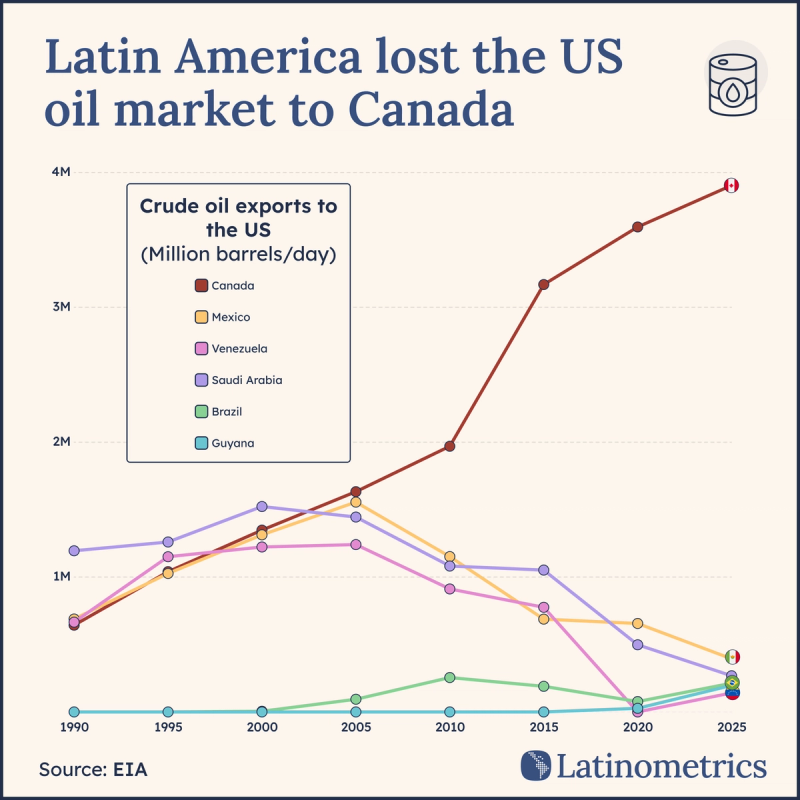
There were certainly doubts about how much the interim Venezuelan government would cooperate with Washington after last month’s snatch-and-grab of autocrat Nicolas Maduro by the US military. However, those doubts quickly dissipated by the end of January with the passing of a major reform of the country’s hydrocarbon law, which unanimously passed the Chavista-run National Assembly with interim President Delcy Rodriguez’s support.
This new law lowers taxes for oil companies and boosts their autonomy, seeking to summon them back to Venezuela after years of being shut out. Venezuela’s government, led by Rodriguez, hopes the reform will attract some of the roughly $100B+ expected to be needed to refurbish and repair the country’s destroyed oil infrastructure.
The United States would stand to benefit, particularly if its oil companies—including Chevron, ExxonMobil, and ConocoPhillips—lead the way back into Venezuela. It’s worth recalling that as late as 20 years ago the United States imported over 1M barrels of oil a day from South America’s oil legend. Of course, a lot can happen in 20 years.
Owing to its car culture, local industry, and gas-pump-sensitive consumers, the US has long had a massive domestic oil demand. While the country’s production has soared in recent years to actually become the world’s largest at over 13M barrels per day, imports remain essential for meeting the US demand and keeping prices low.
Interestingly enough, the type of oil plays a role in the US energy matrix. To accommodate dwindling global supplies of “light, sweet” crude oil in the 1980s-2000s, US refiners spent billions of dollars to build complex downstream units specifically designed to handle heavier, dirtier crude such as that found in Venezuela. One of these refiners, Citgo, is even owned by Venezuela’s state oil company PDVSA.
Ever since the most recent shale oil boom of the 2010s, though, the US has actually been exporting its own lighter crude to other countries while importing the heavier crude of countries like (formerly) Venezuela, Mexico, and especially Canada.
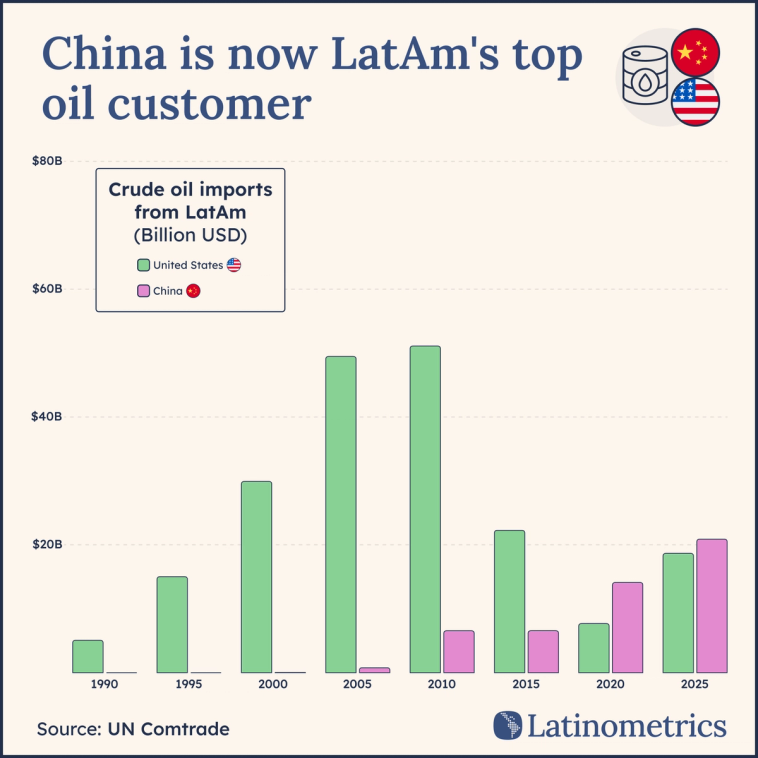
Now, it’s logical that the US has swapped out Venezuela (a relatively hostile state with no land borders) as a source for Canada, a friendly (perhaps too friendly) neighboring state with good pipeline infrastructure. But what’s been happening to Venezuelan oil exports—or indeed, Latin America’s overall oil exports?
As it turns out, when Washington turns it back, Beijing steps up. Chinese crude oil imports from LatAm economies like Brazil, Colombia, Ecuador, and Venezuela have soared since the US began drawing down its regional oil imports.
China, with its massive domestic consumer market and the world’s largest manufacturing base, is naturally a perfect customer for LatAm’s petrostates. But the real question is: with the US so clearly taking steps to redirect at least Venezuela’s crude oil back up north, will China just need to stick to imports from closer oil partners like Iran and Russia?


