
Visualizing Panama's Migration Surge
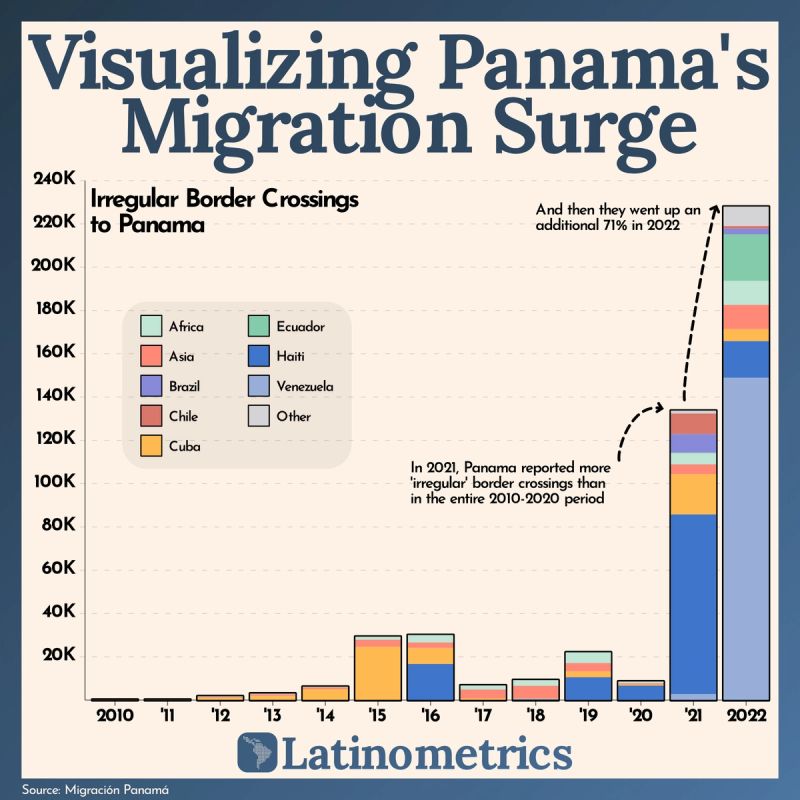
Panama's irregular crossings surged 71% in 2022, with Ecuador up 54x and Venezuela 65%.

The media has widely reported that illegal border encounters from Mexico to the US reached an all-time high in 2022. By year's end, 31% were Mexican citizens, and most detainees were from other LatAm countries.
Less reported is the fact that Panama's Migration authorities recorded a 71% yearly surge in irregular border crossings. Incredibly, this is in addition to the fact that in 2021 they had detained more people crossing the border illegally than in the previous ten years combined.
Venezuelans accounted for 65% of all detained crossings this past year, with 149K. Ecuadorians were the 2nd most detained, with 22K. Ecuador's number went up 54x from 2021 to 2022. Many of these migrants are attempting to cross all of Central America by foot, through its forests, jungles, and deserts, to reach the US-Mexico border. A few weeks ago, President Joe Biden invited Ecuador's president, Guillermo Lasso, to discuss the growing crisis.
So, what is causing so many people to flee home and seek a better life elsewhere? It's worth noting that this issue is not exclusive to Latin America — Asians and Africans more than doubled their illegal crossings into Panama in 2022.
While many causes may compel someone to take the dangerous journey to the border, worsening economic conditions following the Covid-19 pandemic largely account for the surge. However, the countries faring worst may be losing citizens in record numbers due to additional X factors, such as the dictatorships in Cuba, Nicaragua, and Venezuela and Haiti's catastrophic earthquake in 2021.
In the first half of 2022, we made a chart of the largest funding rounds. Looking at the entire year, the slowdown in funding is evident — nine of the biggest ten funding rounds happened in the first half of the year.
The only funding round that made the top 10 post-June went to Colombian neobank Lulo, indicating that as money dries up, big checks are reaching LatAm's more classic startup industry — fintech. Given Nubank is so far LatAm's most successful startup of the decade (now a publicly traded company), and it's also a neobank, perhaps investors consider an emerging Colombian counterpart a safe investment.
Lulo's $200M funding round happened in October. The digital bank received the amount from Abu Dhabi-based International Holding Company. Surely, the co-founder, Jaime Gilinski, the 2nd richest Colombian, inspired investor confidence with his background as a prominent banker and real estate developer.
According to Latam List, Lulo debuted in June last year and has already amassed 120K+ active users as the first digital bank in the country.


