
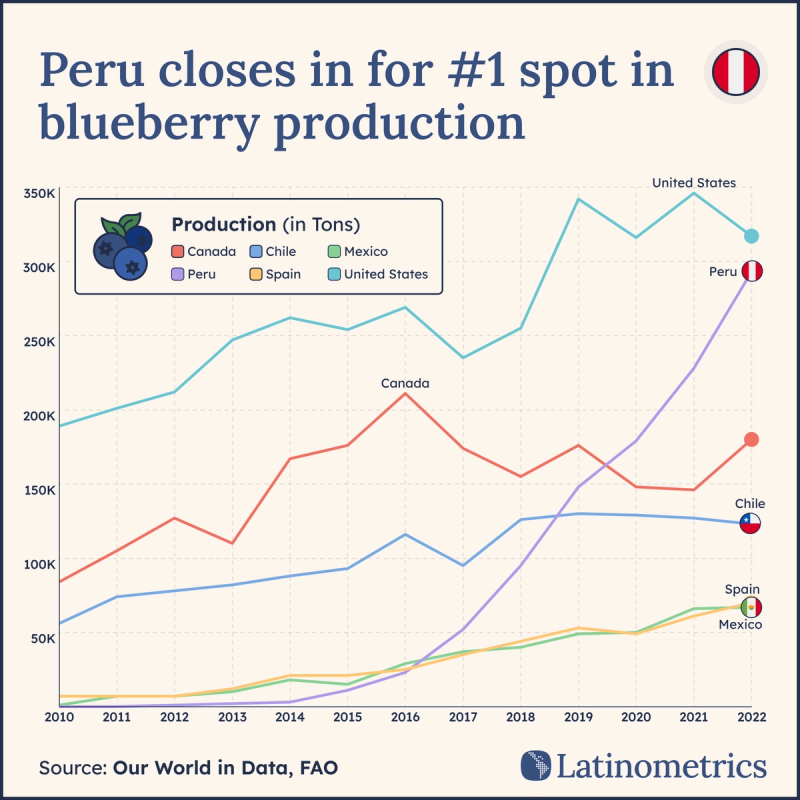
Peru closes in for #1 spot in blueberry production
Seeds of success: The rise of billion-dollar agricultural sectors.

Carlos Gereda was the spark that lit Peru's blueberry boom of the past decade. He asked a simple question: "Can blueberries grow in Peru?"
In 2006, he brought 14 varieties from Chile to see which ones adapted well to the Peruvian climate. He may have taken inspiration from Chile's success in the fruit market, as evidenced by the meteoric rise of cherries and other staples in the new century.
He narrowed it down to four and, in 2009, founded Inka's Berries. The company's service assisted the development of plantations that adhered to the growing standards Carlos had conceived. The blueberry revolution ensued.
In a very short time, Peru became the world's number two producer of blueberries and the world's number one in exports and per capita production.
The growth resembles that of Bitcoin's value. In 2010, Peru produced 30 tons of blueberries; last year, nearly 300K. That means that production multiplied by more than 10,000x in thirteen years.
This new industry (worth $1.4B+ in 2022) that was born seemingly out of nowhere is being led by corporations that can afford the high cost of entry. Most notably, Camposol and Hortifrut hold 34% of the comarket combined.
Peru's climate allows for year-round production, giving the country a competitive edge over seasonal agriculture. The productivity of Peruvian land is 13 tons per hectare. The world's top player, the USA, produces 8 tons per hectare. Given the massive competitive edge, we believe it's only a matter of time before Peru becomes the blueberry capital of the world.
This wouldn't be a first in the region, which serves to feed the rest of the world: Chile overtook the US for 2nd place in cherry production in 2021. As of 2022, it produces more than the US and Uzbekistan (the 3rd and 4th biggest producers) combined. It's now competing with Turkey to become number one.
These stories exemplify the vital position Latin America has assumed in the world of agriculture, and the evidence suggests that that role will continue for decades.


