
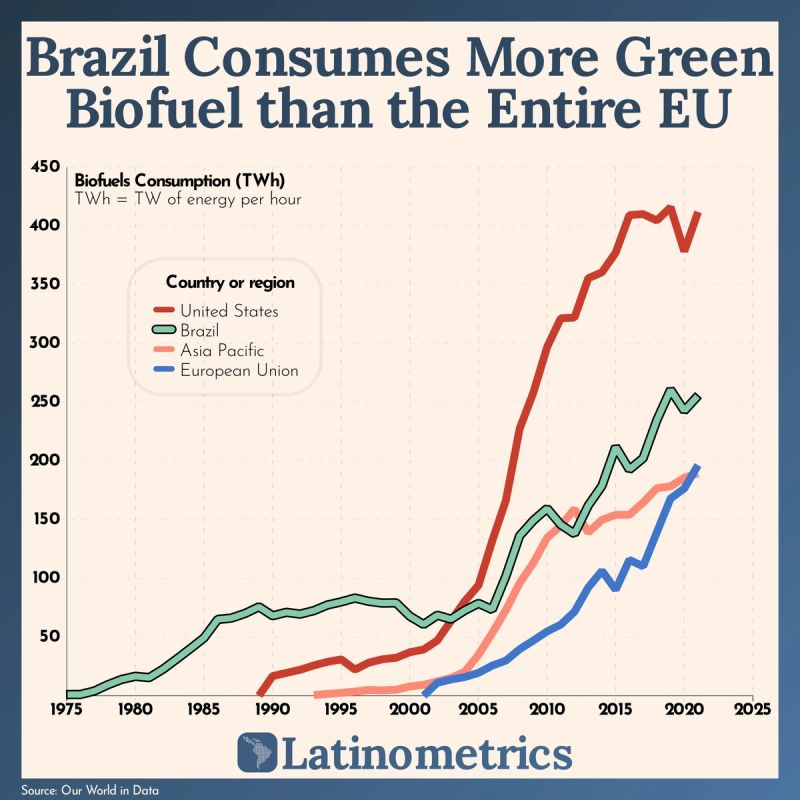
Brazil Consumes More Green Biofuel than the Entire EU
Brazil outpaces the EU in green biofuel consumption, thanks to sugarcane ethanol that curbs emissions by 96%.

Brazil is one of the luckiest countries regarding geography and natural resources. Not only is it home to 60% of the largest rainforest — the Amazon, and the 2nd longest waterways. It's also the 5th country with the most arable land.
Just like the waterways enable the country to produce an immense amount of green energy through hydroelectric power, its vast arable land makes the economics of farming possible to produce ethanol fuel from sugarcane. This ethanol or ethyl alcohol is the same substance that makes people drunk. Because sugarcane can be re-planted unlimited times, ethanol fuel is considered a renewable form of energy.
None of Brazil's cars run on pure gasoline, which, as most of us know by now, emits CO2 and contributes to global warming. Instead, they run on a blend of gasoline and sugarcane ethanol, which can curb greenhouse gases by up to 96%.
Although our chart makes it look like the US has a more impressive output of biofuel than Brazil, the US uses corn for its ethanol, which has a 7x worse energy balance than Brazil's sugarcane product.
It's not only natural gifts that make Brazil one of the greenest places in the world. Those who have made effective use of resources deserve praise. In 1978, Fiat introduced the 147 to the Brazilian market — the world's first car that ran on ethanol. The development of such a vehicle at scale was possible thanks to government incentives, like the nationwide "Proalcol" (pro-alcohol) program, which mandated all gasoline to have some ethanol mixed in.
Thanks to these efforts, Brazil has created a system that many countries envy, and increasingly so. As Europe suffers through an energy crisis, it's turning to Brazil's ethanol as an alternative to natural gas — ethanol exports to Europe increased 3x compared to last year.


