
Brazil’s $88B in public energy investments
Brazil's $88B public energy bet fuels a potential $1T clean energy future.

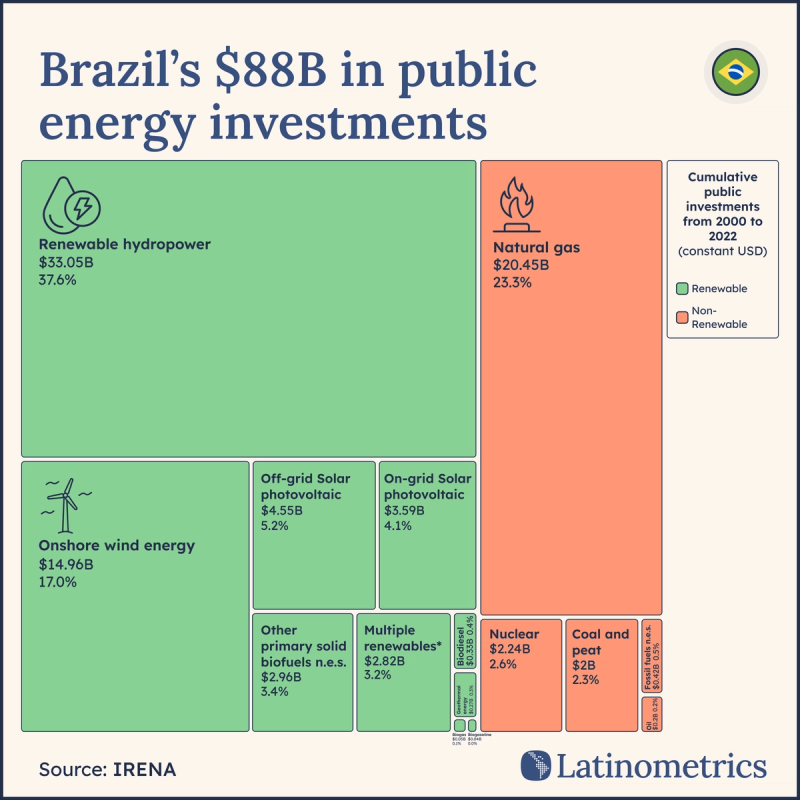
No single country better embodies Latin America's energy wealth than Brazil, the region's giant.
Brazil has it all: massive oil and gas deposits, sprawling offshore wind farms, and half of the Itaipu Dam, one of the world's largest hydroelectric dams.
The country has become the top oil producer in Latin America, surpassing both Mexico and Venezuela, with production growing 13x since 1980. Meanwhile, its green energy matrix towers above most neighboring countries.
Of course, private investment has helped make this possible. But don't count out the $88B Brazil has channeled towards energy through public investment.
In Brazil, the state plays a fairly significant role in specific industries. For example, Brazilian state-owned oil giant Petrobras has been active in the discovery and exploitation of offshore oilfields, including in both the Campos and Santos basins off the country's southeastern coast. They now want to drill at the mouth of the Amazon River.
As successive national governments set green or energy priorities, they have tools at their disposal to mobilize funding. Leading the charge is the Brazilian national development bank, BNDES, with $132B in assets under management. It serves as the undisputed locally powered anchor, providing more capital than the China Development Bank and the European Investment Bank combined to fund priorities such as hydropower.
Foreign financial institutions have also stepped in, including the International Finance Corporation and the European Investment Bank—the latter of which has committed loans as part of the European Commission's €45B Global Gateway Investment Agenda for Latin America and the Caribbean.
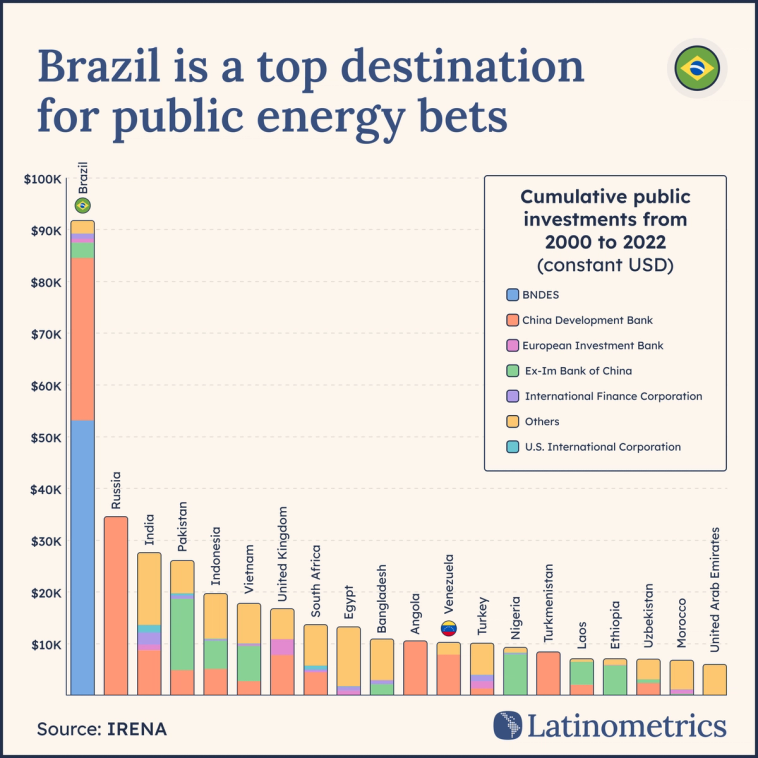
Meanwhile, there are meaningful active Chinese policy banks, such as the China Development Bank and the Export-Import Bank of China, which have cumulatively loaned over $120B to Latin American countries over the last two decades.
BNDES and these various foreign bodies won't be able to cover the gap entirely themselves. Even $88B has its limits when it comes to powering the world's 7th-largest country.
According to BloombergNEF, the opportunity for clean energy from now until 2050 sits in the Trillion-dollar range.


