
Brazil's Household Debt Has Grown 3x in the Last 20 Years
Brazil's debt tripled in 20 years, but it's a "good, balanced example" for development.

Is debt good or bad?
Let's say you take out a $100K loan with an interest rate of 10% compounded annually and a repayment period of 10 years. You end up paying $55K in interest over that period, plus the borrowed amount for the benefit of receiving $100K in advance. Taking out this loan doesn't make sense for you unless one of two options is true:
The value you get from borrowing the money is worth the interest paid, and there's no other way you could've paid. For example, a mortgage or hipoteca is the only option for you to buy your dream home.
You will take the $100K and, through a business or investment, will make more than the $55K you end up paying in interest payments.
Cautious debt undoubtedly opens countless possibilities. It allows entrepreneurship and businesses to form and create value for societies through their products or services. It also enables average citizens to raise their living standards through home ownership.
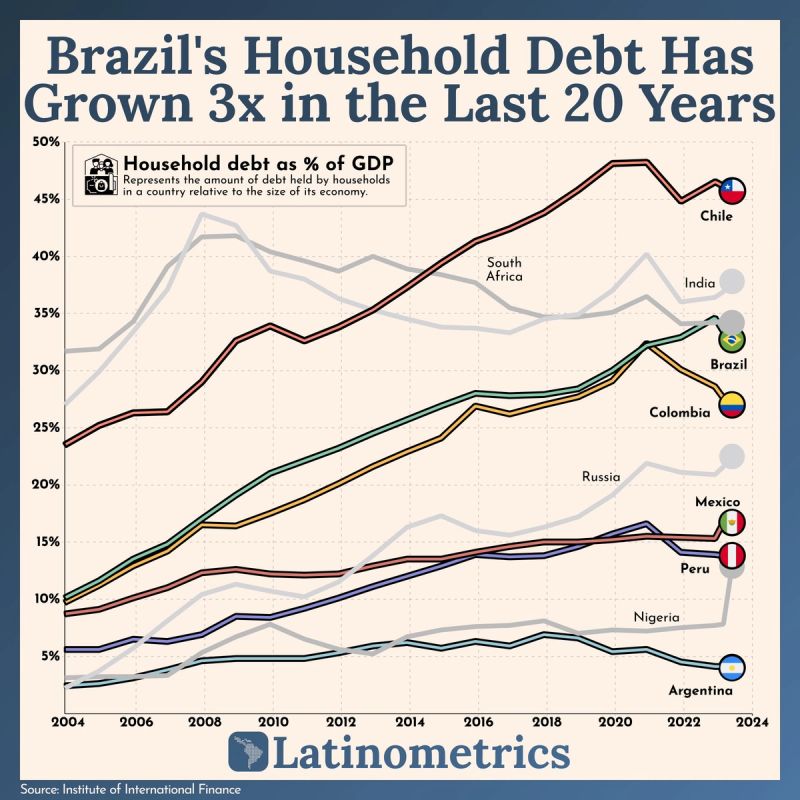
Chile, Brazil, and Colombia lead Latin America's willingness or ability to incur debt. Household debt as a % of GDP represents the amount relative to a country's economy.
In the past 20 years, Colombia and Chile's household debt as a % of GDP has more than doubled. In the case of Brazil, it has tripled. LatAm's second-largest economy, Mexico, has remained practically stagnant at about 17%. Argentina's figure sits at a meager 4%.
Many developed countries have much higher percentages than even Chile. Switzerland, Australia, and Canada are extreme examples where household debt as % of GDP is higher than 100%. A ratio that high is by no means a good thing, but it seems certain that the direction Chile and Brazil are going in is a good, balanced example of debt for development.


