
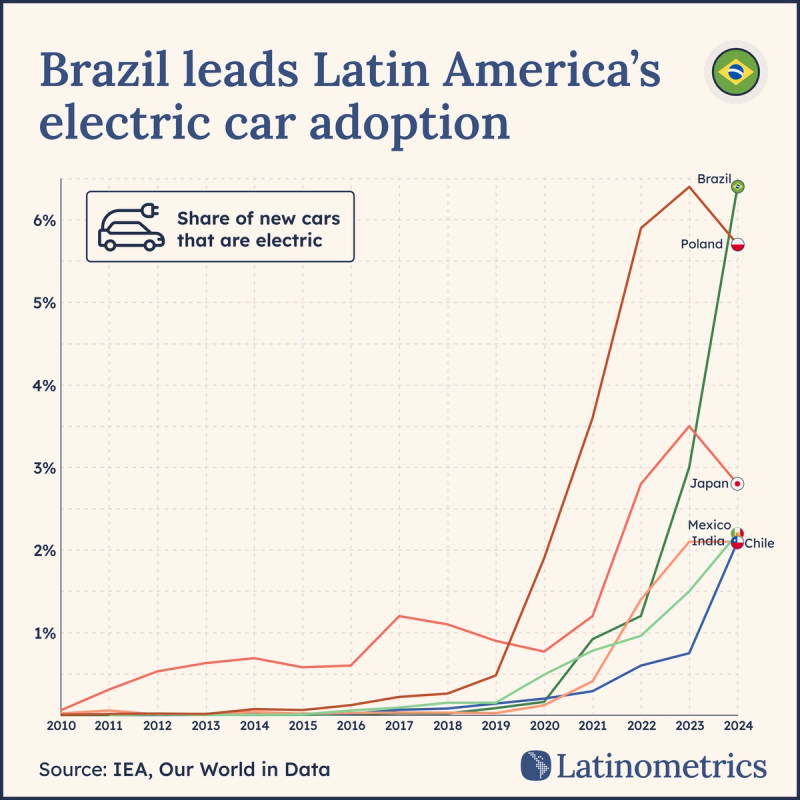
Brazil leads Latin America's electric car adoption
A decade-old tariff bet is paying off for Latin America’s biggest car market.

A quick drive around Mexico today and you’re likely to see the same three words on the back of half the cars in front of you.
Build Your Dreams.
Within Latin America, EV adoption has stuttered compared to other regions, but the arrival of cheaper Chinese competitors like BYD and Great Wall Motors (GWM) has made the switch slightly more accessible. Brazil, by far the region’s leader, even eliminated tariffs on manufacturers like these a decade ago in an effort to spur EV adoption, although since last year it’s reimposed small, gradually growing tariffs in order to prevent dumping.
In fact, both BYD and GWM have opened factories in recent years in Brazil, as they attempt to get around the eventual 35% tariffs they’ll be facing next year—high, although still much lower than the 45% they face in the European Union and the over 100% they face in the United States.
Brazil, which has by far the largest domestic car market in the Americas outside of the US, has long been a top priority for manufacturers from around the world, including established giants like Volkswagen and Stellantis. However, lower purchasing power and fewer charging station coverage have made the country less attractive to traditional EV players like Tesla.
In fact, EV charging stations are another sector where China dominates: the country was responsible for 75-85% of all stations supplied in Latin America last year.
Clearly, it has a long way to go in terms of leveraging this important new technology and not remaining stuck forever in the days of the gas pump. But as Brazil nears a double-digit rate of new cars being electric, inching ahead of more developed countries like Japan and Poland, it’s evident that the rest of the region has lots to learn from their samba-loving peers.
After all, 125K units sold in a year isn’t too bad, especially when that figure represents an impressive 55% growth over the previous year.


